

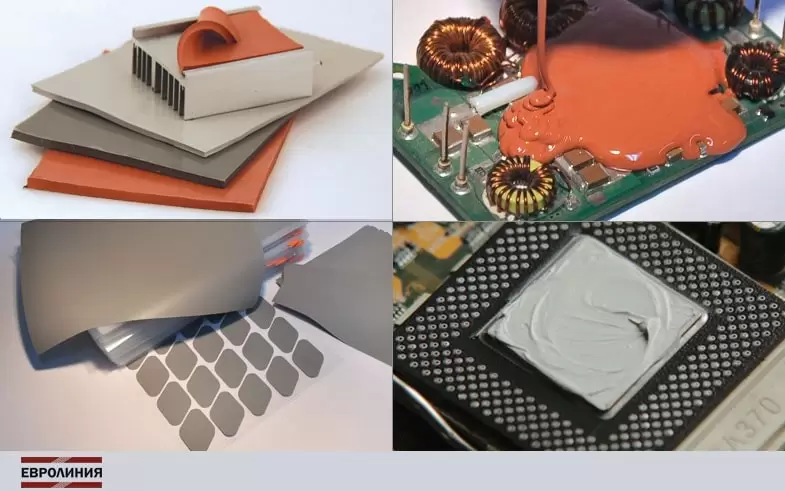
Thermally conductive electrical insulating highly elastic gel sheet materials NOMACON ™ KPTD-2M


TCEI - Thermally Conductive Elastic Insulating Material
Qualitative indicators:
KPTD-2M / 1-0.25
KPTD-2M / 1-0.50
KPTD-2M / 1-1.00
KPTD-2M / 1-2.00
KPTD-2M / 1-3.00
KPTD-2M / 1-4.00
KPTD-2M / 1-5.00
KPTD-2M / 2-0.25
KPTD-2M / 2-0.50
KPTD-2M / 2-1.00
KPTD-2M / 2-2.00
KPTD-2M / 2-3.00
KPTD-2M / 2-4.00
KPTD-2M / 2-5.00
KPTD-2M / 3-0.25
KPTD-2M / 3-0.50
KPTD-2M / 3-1.00
KPTD-2M / 3-2.00
KPTD-2M / 3-3.00
KPTD-2M / 3-4.00
KPTD-2M / 3-5.00
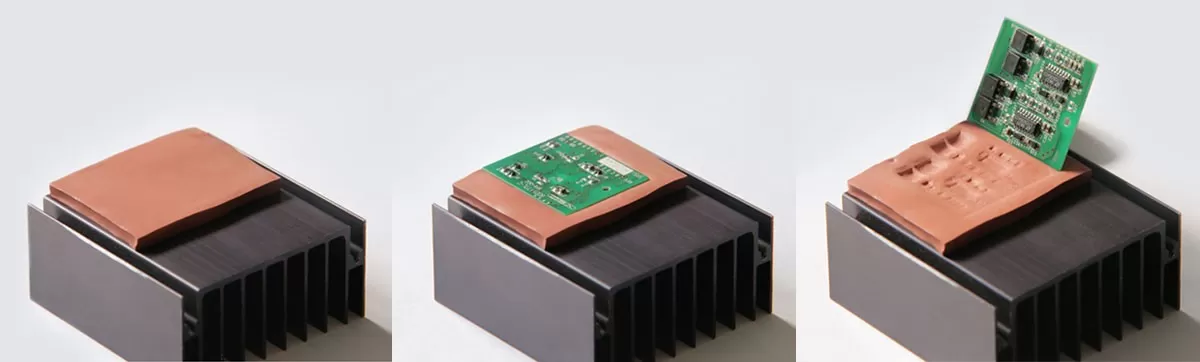
Due to the special elastic gel-like silicone, KPTD-2M materials are extremely easy to deform (spread) when compressed and adhere tightly to all components of the printed circuit board, filling irregularities and voids. Such materials, with a sheet thickness of 0.25-6.0 mm, can serve as a gasket between the entire printed circuit board and a heat sink, for example, a metal case of a device or a radiator, providing high-quality volumetric heat dissipation.
Products from sheet materials KPTD-2M, which we call Heat-Conducting Plastic Enveloping Pads, or HCPE ™ Pads (HCPE ™ -pads, HCPE ™ 3D-pads), are analogs of modern materials Gap Pad®, Gap Filler® and Softtherm® from well-known manufacturers ...
KPTD-2M materials are produced in the form of rectangular sheets. Standard sheet sizes are 150x110 mm and 150x220 mm. Standardized sheet thickness when ordering is 0.25, 0.50, 0.75, 1.0, 1.5, 2.0, 3.0, 4.0, 5.0 and 6.0 mm. Sizes and thickness of other non-standard sheets upon delivery are to be agreed with consumers.
NOMACON TM KPTD-2M materials provide efficient heat dissipation and electrical insulation due to the increased heat-conducting and dielectric properties of ceramic fillers, comfort to contact surfaces (they have natural double-sided stickiness), and pronounced thermal relaxation.
Materials grade KPTD-2M / 1 are made by filling a gel silicone base with micropowders of highly purified oxide ceramics, recrystallized using a special technology at temperatures above 2000 ºС (α-Crystalline).
Materials grade KPTD-2M / 2 are made on the basis of oxide and nitride ceramic micropowders, sintered using a unique technology in a highly purified nitrogen environment at temperatures above 1200 ºС (β-Cristalen ™). Materials grade KPTD-2M / 3 are made on the basis of nitride ceramic micropowders.
Materials grade KPTD-2M / 1-VN are made by maximizing the filling of a gel silicone base with fractions of micropowders of highly purified oxide ceramics with particles of regular spherical shape, which have an extremely high thermal conductivity of the recrystallized material.
Materials grade KPTD-2M / 2-VN are made by maximizing the filling of a gel silicone base with fractions of micropowders of highly purified oxide ceramics with regular spherical particles in combination with fractions of micropowders of oxide and nitride ceramics sintered using a unique technology in an environment of highly purified nitrogen at temperatures above 1200 ºС (β-Cristalen ™).
Sheet materials NOMACON ™ KPTD-2M are manufactured by the method of step-by-step contact casting under pressure - molding... In this case, the sheet material is a close-packed structure of uniform thickness with a sufficiently smooth and even surface.
High technical and consumer properties of KPTD-2M materials are achieved due to the following technological methods:
- application of a silicone gel base with maximum elasticity (penetration) and residual surface tack;
- maximum filling of the silicone base with micropowder with an optimal combination of various fractions of micropowders of a heat-conducting ceramic filler;
- the use of specially developed heat-conducting dielectric micropowders α-Crystalline, β-Crystalline and nitride ceramics of various fractional composition;
- obtaining under pressure a close-packed structure of a material homogeneous in thickness in the absence of pronounced internal gas cavities;
- the use of a reinforcing electrical insulating fiberglass base for materials with a thickness of 0.25-1.5 mm;
- application of the technology of glossy calibration of the sheet surface in order to achieve maximum conformity to the pressing surfaces.
Specifications
Technical characteristics of sheet materials NOMACON ™ KPTD-2M
| Name | Standard according to TU RB 100009933.004-2001 | Control methods | ||
|---|---|---|---|---|
| Material grade | ||||
| KPTD-2M / 1 | KPTD-2M / 2 | KPTD-2M / 3 | ||
| Appearance | Highly elastic rubbery homogeneous sheet material | Visually | ||
| Color | Pink, gray (¹) | Brown, gray (¹) | Gray | Visually |
| Density, g / cm³ | 2,05-2,20 | 1,90-2,10 | 1,80-2,00 | GOST 15139 |
| Shore A / Shore OO hardness, units | 4-10 / 30-40 | GOST 263 | ||
| Thickness, mm | 0.20 to 6.0 | GOST 11358 | ||
| Stickiness, N / m, not less | 100 | GOST 28019 | ||
| Nominal working compressive stress, MPa, not less, at material thickness, mm | GOST 26605 clause 5.12 TU | |||
| 0,20 | 2,2 | GOST 26605 clause 5.12 TU | ||
| 0,30 | 1,5 | GOST 26605 clause 5.12 TU | ||
| 0,50 | 0,6 | GOST 26605 clause 5.12 TU | ||
| Ultimate compressive stress, MPa, not less, with material thickness, mm |
7,5 |
GOST 26605 clause 5.12 TU | ||
| 0,20 | 7,5 | GOST 26605 clause 5.12 TU | ||
| 0,30 | 5,5 | GOST 26605 clause 5.12 TU | ||
| 0,50 | 2,8 | GOST 26605 clause 5.12 TU | ||
| Ultimate compression ratio (elasticity), %, not less | 50 | GOST 26605 clause 5.12 TU | ||
| Electric strength, kV / mm, not less |
GOST 6433.3 | |||
| at constant voltage | 25 | 20 | 15 | GOST 6433.3 |
| at alternating voltage | 18 | 15 | 10 | GOST 6433.3 |
| Specific volumetric electrical resistance, Ohm • cm, not less | 1014 | 1013 | 1012 | GOST 6433.2 |
| Dielectric constant, at 1000 Hz, no more | 6,5 | GOST 22372 | ||
| Dielectric loss tangent, at 1000 Hz, no more |
0,0045 | GOST 22372 | ||
| Thermal conductivity, W / (m • K), not less | 0,80 | 1,10 | 1,40 | ASTM D 5470 GOST 12.4.145 |
| Specific thermal resistance, (K • cm²) / W, with a sheet thickness of 0.25 ± 0.02 mm and a compression pressure of 0.69 MPa (100 psi), (in TO3, TO220 format), no more | 3,20 | 2,50 | 2,10 |
ASTM E 1530 |
| (¹) - The color can be changed by agreement with the consumer | ||||
Technical characteristics of sheet materials NOMACON ™ KPTD-2M-VN
|
Name |
Standard according to TU RB 100009933.004-2001 rev. 5 |
Control methods |
|
|---|---|---|---|
|
Material grade |
|||
|
KPTD-2M / 1-VN |
KPTD-2M / 2-VN |
||
|
Appearance |
Highly elastic rubbery homogeneous sheet material |
Visually |
|
|
Color |
Pink, gray (¹) |
Brown, gray (¹) |
Visually |
|
Density, g / cm³ |
2,75-2,85 |
2,60-2,65 |
GOST 15139 |
|
Shore A / Shore OO hardness, units |
0-5 / 30-35 |
GOST 263 |
|
|
Thickness, mm |
0.25 to 6.0 |
GOST 11358 |
|
|
Stickiness, N / m, not less |
100 |
GOST 28019 |
|
|
Nominal working compressive stress, MPa, not less, at material thickness, mm |
|||
|
0,20 |
1,8 |
GOST 26605 clause 5.12 TU |
|
|
0,30 |
1,1 |
GOST 26605 clause 5.12 TU |
|
|
0,50 |
0,4 |
GOST 26605 clause 5.12 TU |
|
|
Ultimate compressive stress, MPa, not less, with material thickness, mm |
GOST 26605 clause 5.12 TU |
||
|
0,20 |
5,0 |
GOST 26605 clause 5.12 TU |
|
|
0,30 |
3,5 |
GOST 26605 clause 5.12 TU |
|
|
0,50 |
1,8 |
GOST 26605 clause 5.12 TU |
|
|
Ultimate compression ratio (elasticity), %, not less |
50 |
GOST 26605 clause 5.12 TU |
|
|
Electric strength, kV / mm, |
GOST 6433.3 |
||
|
at constant voltage |
25 |
GOST 6433.3 |
|
|
at alternating voltage |
18 |
GOST 6433.3 |
|
|
Specific volumetric electrical resistance, Ohm • cm, not less |
1014 |
GOST 6433.2 |
|
|
Dielectric constant, at 1000 Hz, no more |
6,5 |
GOST 22372 |
|
|
Dielectric loss tangent, |
0,0045 |
GOST 22372 |
|
|
Thermal conductivity, W / (m • K), not less |
2,0 |
2,5 |
ASTM D 5470 |
|
Specific thermal resistance, (K • cm²) / W, with a sheet thickness of 0.25 ± 0.02 mm and a compression pressure of 0.69 MPa (100 psi), (in TO3, TO220 format), no more |
1,60 |
1,40 |
ASTM E 1530 |
|
(¹) - The color can be changed by agreement with the consumer |
|||
KPTD-2M materials have a service life at a temperature of plus 200 ° C for at least 2500 h, at a temperature of plus 250 ° C for at least 1500 h.
Type of climatic modification of KPTD materials in the state of polymerization B1.1 in accordance with GOST 15150.
The service life in products with placement category 4 in accordance with GOST 15150 is at least 10 years.
Heat conducting properties
Heat-conducting properties of gaskets made of KPTD-2M materials
To assess the heat-conducting properties of sheet materials, a mathematical model for calculating thermal resistance is used, presented above on the site page "DESCRIPTION - Thermal resistance of KPTD materials". In this case, the total specific thermal resistance to heat transfer R(see formula 2) includes thermal resistance at the boundary "heat-transfer contact surface - gasket surface" R1S, thermal resistance depending on thickness δ and thermal conductivity λ gasket material δ / λ, as well as thermal resistance at the boundary "gasket surface - heat-receiving contact surface" R2S.
It should be noted that due to the conformal surface and high elasticity, the thermal resistance of KPTD-2M materials is stabilized even at a compression stress of 0.4-0.7 MPa (see the graph of the specific thermal resistance versus compression stress). For materials with a thickness of 0.25-1.0 mm at a compression stress of up to 0.7 MPa, the change in thickness during compression can be calculated with sufficient accuracy using formula 5, taking into account dependence 11 of the section "DESCRIPTION - Elasticity (compressibility) of KPTD materials". With a further increase in the compressive stress, the thermal resistance depends only on the residual thickness of the material. When an additional adhesive layer or positioning grease is applied, the total specific thermal contact resistance for thin sheets decreases slightly (see value R0S).

The value of thermal resistance of gaskets made of various grades and thicknesses of KPTD-2M materials can be determined using the following values empirical coefficients:
- материал листовой КПТД-2M/1 RS = 0.23 (K⋅ cm²) / W, R0S = 0.19 (K⋅ cm²) / W, λ = 0.87 W / (m⋅K);
- материал листовой КПТД-2M/2 RS = 0.23 (K⋅ cm²) / W, R0S = 0.19 (K⋅ cm²) / W, λ = 1.14 W / (m⋅K);
- sheet material KPTD-2M / 3 RS = 0.23 (K⋅ cm²) / W, R0S = 0.19 (K⋅ cm²) / W, λ = 1.44 W / (m⋅K);
- The above mathematical model for calculating the thermal resistance of sheet materials KPTD-2M at compressive stresses up to 1.7 MPa gives good convergence of the results provided that the requirements for compressive contact surfaces are met, which are presented in the section "Instructions for use".
Example 3.
In the conditions of example 1 (see the section of the website "Heat-conducting electrical insulating compounds KPTD-1"), the motor controller board for the purpose of complex heat removal is installed in an aluminum case through a heat-conducting electrical insulating gasket made of NOMACON ™ KPTD-2M / 1-0.50 material. The compression force of the gasket during installation was P = 365 H.
- According to the marking of the material, we take the initial thickness of the pad δ0 = 0.50 mm;
- Accept values RS = 0.23 (K⋅ cm²) / W, λ = 0.87 W / (m⋅K); for material KPTD-2M / 1;
- We accept the resulting compression stress of the gasket during installation σ = 0.35 MPa from formula 6, modulus of elasticity E = 27.8 MPa / mm according to formula 11 and residual thickness according to formula 5: δ = 0.487 mm;
- We calculate the specific thermal resistance R = RS + δ / λ, R = 5.83 (K⋅ cm²) / W;
- Determine the thermal resistance of the gasket RF according to formula 4: RF = 0.556 K / W;
- We calculate the temperature difference using formula 1: ΔT = RF ⋅ Q ΔT = 8.3 ° C.
For example 3, when using the material KPTD-2 / 3-0.20-LK, we have:
λ = 1.44 W / (m⋅ K), R = 3.62 (K⋅ cm²) / W, RF = 0.344 K / W, ΔT = 5.16 ° C.
Designation when ordering
Thermally conductive electrical insulating sheet material
NOMACON ™ KPTD-2M / 1-H-LxB THAT RB 100009933.004-2001
or
Sheet BxL KPTD-2M / 1-N TU RB 100009933.004-2001
or
Sheet BxL KPTD-2M / 1-VN-N TU RB 100009933.004-2001
Where KPTD-2M / 1 - material grade;
-2M - material of the second type "soft" (sheet highly elastic gel polymerized material);
/1 - the first series in terms of the composition of the ceramic filler (in total, the compositions of the ceramic filler of series 1, 2, 3 are included);
VN - material of "high filling" with heat-conducting micropowders H - sheet thickness, mm;
BxL - width x length of a rectangular sheet, mm;
Directions for use
- KPTD-2M materials are used as delivered. Before use, mark and cut the required spacer without removing the protective films from the surface of the material. Then peel off the front protective film and adhere the gasket to one of the heat transfer contact surfaces. Carefully peel off the second protective film from the gasket and press the other heat transfer surface against the surface of the material.
- Determine the required compression force of the contact surfaces between which the gasket is installed. It should be borne in mind that the nominal working compressive stress (MPa) determines the permissible relative deformation of the material sheet in the range from 10% to 50 % from its original thickness, at which the manufacturer guarantees the strength, electrical insulating and heat-conducting properties presented in the table "Technical characteristics".
- The ultimate compressive stress determines the relative deformation of the material within the range of up to 50% from its original thickness, at which there is no loss of elasticity, and subsequently, when the compressive stress is removed, the material is restored to its original thickness and retains its properties. Operation of gaskets made of KPTD-2M material when exceeding the limiting compression stress is not allowed.
- The quality of the compressive surfaces (the device and the radiator must comply with GOST 265 in order to achieve the normalized heat transfer properties of the gasket. The roughness of the compressive surfaces should not exceed Ra = 0.63 μm in accordance with GOST 2789. The deviation of the geometry of the compression surfaces in terms of flatness and parallelism should not exceed the degree of accuracy 7 in GOST 24643. The presence of burrs and other defects on the contact surfaces can violate the integrity of the gasket, and, accordingly, the required electrical insulation.
- The efficiency of heat removal through a gasket made of material is determined by the compressive force of the surfaces of the device and the radiator, their flatness and parallelism during assembly, as well as the presence of residual air cavities between the gasket and the clamping surfaces. In order to maximize the squeezing out of air pockets, it is recommended to apply the gasket with a glossy surface or a surface with a sticky layer to the highest quality pressure surface and roll it with a rubber roller.
- To isolate semiconductor devices from the heatsink housing when fastening with screws, use insulating sleeves NOMACON ™ M2.5 and M3 made of heat-resistant polyamide.
- When using large format gaskets with a surface area of 20 to 1200 cm², there is often a problem of high-quality preparation of contact surfaces. At the same time, the thickness and elasticity of the gasket is not enough to compensate for the defects of the surfaces themselves during compression, as well as their flatness and parallelism during assembly. In order not to increase the thickness of the gasket, leading to an increase in thermal resistance, it is recommended to first apply the appropriate heat-conducting paste NOMACON ™ KPTD-3 to the contact surfaces and then install and roll the gasket.
- It is prohibited to store, manipulate and use the KPTD-2 (KPTD-2M) materials at temperatures below minus 60 ° C and above plus 250 ° C.

manufacturer's warranty
- The manufacturer guarantees the conformity of NOMACON ™ KPTD-2M sheet materials to the requirements of technical specifications, subject to the conditions of transportation, storage and use.
- The shelf life of KPTD-2M materials without a sticky layer in the manufacturer's packaging is 24 months.
- The shelf life of KPTD-2M materials with a sticky layer and positioning grease in the manufacturer's packaging is 6 months.
- The loss of stickiness of KPTD-2M materials after the expiration of the consumer's shelf life is not a rejection factor.
- After the expiration of the shelf life, the KPTD-2M materials are tested before each use for compliance with the technical requirements. Subject to compliance, the materials can be used for their intended purpose.
- Complaints and claims for quality are accepted when returning products in the manufacturer's packaging with the provision of copies of accompanying documents for the products received from the manufacturer (invoice, quality certificate).
 English
  Русский