

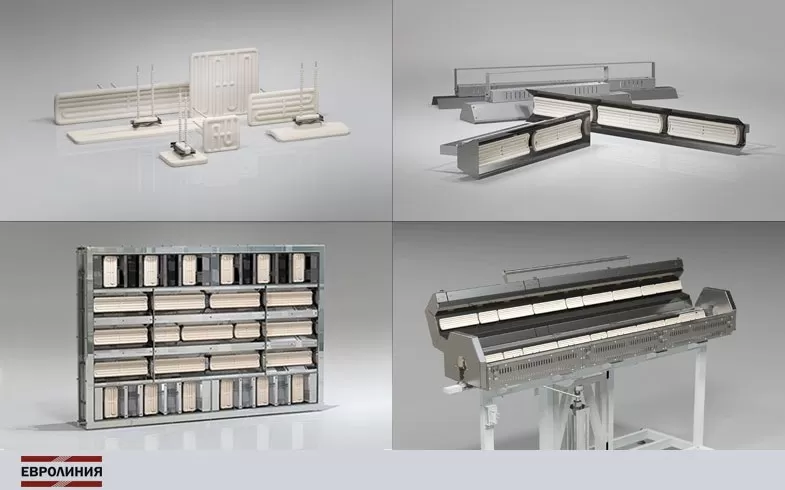
Directional infrared heating
Directional infrared heating - this is the most effective way of heating local workplaces and production areas in open rooms, sheds and sites, in semi-open rooms, for example, with permanently open transport openings, in closed difficult-to-heat rooms with, for example, constantly operating supply and exhaust ventilation, etc. P.
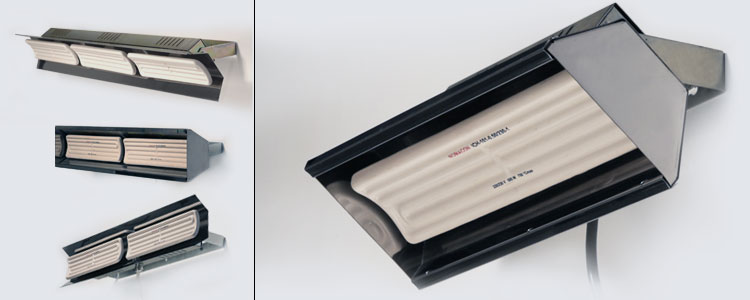
The purpose of this research is to develop a method for calculating local directional infrared heating systems using infrared heaters of the series NOMAKON EIUS-100/200 [1-2] (see Figure 1) that meet the requirements of existing regulatory documents governing the microclimate indicators of industrial premises equipped radiant heating systems (SLO) [3-5].
Features of exposure to radiant heating systems (SLO)
The peculiarities of the microclimate under the influence of the SLO are that a person feels well if the release of heat by his body and the loss of heat by the body into the surrounding space are in equilibrium. The heat balance is disturbed if at low ambient temperatures the amount of heat given off becomes greater than the amount of heat generated in the human body. The resulting difference in the amount of heat, which, for example, at an ambient temperature of plus 10 ° C, can reach up to 150 W cm2 the human body, must be communicated to the person by additional directional infrared heating.
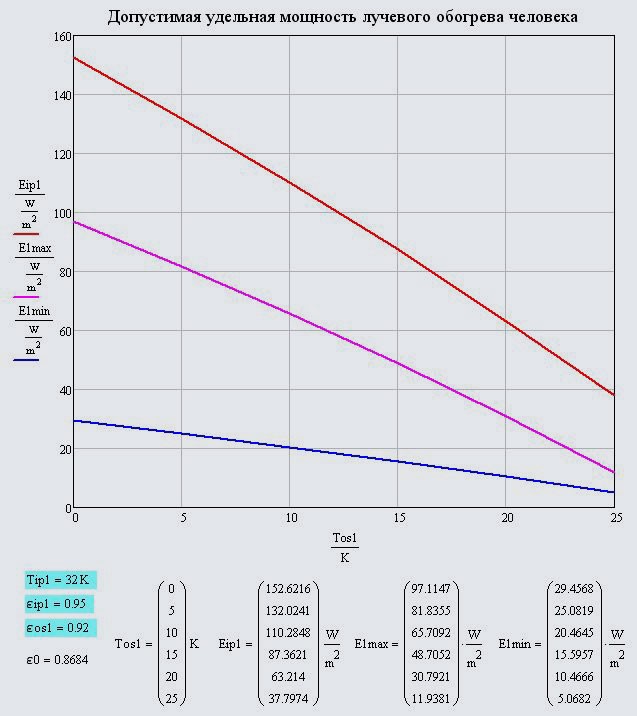
In standard tests [6], to assess the heat loss of the human body by thermal radiation, the temperature of the body surface (skin) is taken Tip1 = 32 ° C and emissivity (degree of blackness) of human skin εip1 = 0.95. Assuming the temperature of the surrounding walls and ceiling (background radiation sources per person) is within Tos1 = 0-16 ° C at the degree of blackness εos1 = 0.92 (plaster, brickwork, wallpaper), then the calculated heat loss by radiation of a naked body (as a result of the true radiation of the body and radiation of background sources) according to the Kirchhoff equation will be, W / m2:

Where
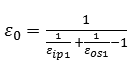
- reduced degree of blackness of the system "human skin - surrounding background",
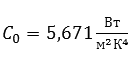
Is the constant of the Stefan-Boltzmann equation, Tip1 and Tos1 expressed in degrees Kelvin.
Taking into account the peculiarities of the irradiation of a dressed person on the basis of comparing the radiation energy of the body according to formula (1) and the limiting thermal exposure from the regulatory documents given in Table 1, it is possible to take the boundary values of the specific powers of thermal exposure for the range of effective heating from E1max before E1min at different ambient temperatures Tos1:

Microclimate of industrial premises equipped with SLO
Table 1. Indicators of the microclimate of industrial premises equipped with SLO
| Temperature of air, environment ° С | SanPiN 9-80 RB 98 [3] GOST 12.1.005-88 [5] Intensity of thermal radiation, W / m2, no more, with the irradiated surface of the body 50% and more | SP 2.2.1.1312-03 [4] | ISO 7726: 1998 [6], formula (1), W / m2 | |
|---|---|---|---|---|
| Intensity of thermal irradiation of the head, W / m2, no more | Intensity of thermal irradiation of the body, W / m2, no more | |||
| 0 | — | — | — | 153 |
| 5 | — | — | — | 132 |
| 10 | — | — | — | 110 |
| 11 | — | 60 | 150 | 106 |
| 12 | 35 | 60 | 125 | 101 |
| 13 | 60 | 100 | 97 | |
| 14 | 45 | 75 | 92 | |
| 15 | 30 | 50 | 87 | |
| 16 | 15 | 25 | 83 | |
| 20 | — | — | 63 | |
| 25 | — | — | — | 38 |
These regulatory documents are given for the period of an 8-hour work shift in relation to a person wearing a set of clothing with thermal insulation (thermal resistance) 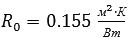 (overalls from general pollution) and performing work of moderate severity (category IIa - IIb). (overalls from general pollution) and performing work of moderate severity (category IIa - IIb). |
||||
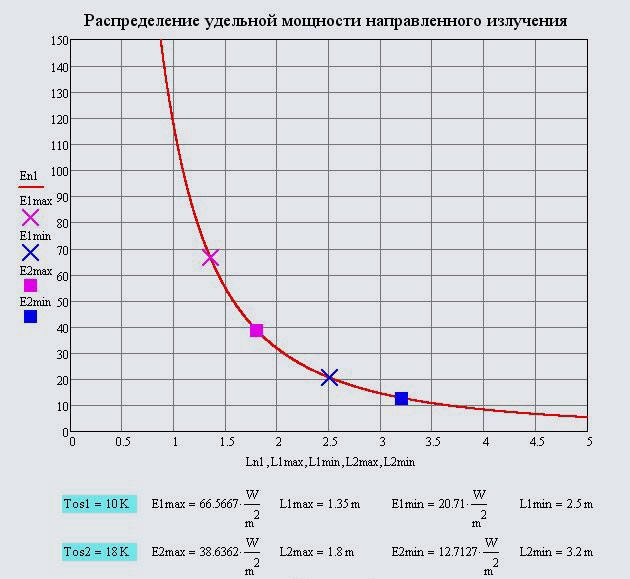
Thus, depending on the ambient temperature, electrical power and design of the heater, as well as on the normal distance from the radiation surface to the heating object (see the section "Infrared radiation characteristics - engineering applications"), it is possible to distinguish three zones of radiant heating in a room. equipped with an SLO: a zone of increased intensity of thermal irradiation at E1 > E1max, effective heating zone at E1min ≤ E1 ≤ E1max, as well as a zone of comfortable, but insufficient heating at E1 <E1min.
It should be noted that the above division into zones (see Figure 2), calculated by formulas (2-3) taking into account expression (1), is necessary for subsequent calculations when the heater is turned on for the first time, as well as when the SLO enters the specified mode of maintaining the temperature in room. As the room temperature rises, the boundaries E1max before E1min will shift towards lower values E1 and it is important to locate heating objects (workers, equipment, etc.) in the room in such a way that they are constantly in the zone of effective heating, or in the zone of comfortable heating near the border of the zone.
To calculate the distribution of heating zones when using SLO based on EIUS-211 electric heaters, we will use the data in Table 2. We accept the initial temperature in the room Tos1 = 10 ° C, room temperature after warming up (with thermal stabilization) Tos2 = 18 ° C and using formula (1) we calculate the values of the limiting intensity of thermal radiation Eip1 = 111.4 W / m2, Eip2 = 73.8 W / m2 Using formulas (2) and (3), we calculate the boundary values of the irradiation zones: E1max = 66.5 W / m2, E1min = 20.7 W / m2 for the initial warm-up period, E2max = 38.6 W / m2, E2min = 12.7 W / m2 - for the period of thermal stabilization.
Specifications
Table 2. Technical characteristics of IR electric heaters EIUS-211
| Indicator name | Electric power of TSC-101 emitter | ||||
|---|---|---|---|---|---|
| 250 | 400 | 500 | 650 | 1000 | |
| Dimensions of the emitter in plan, calculated area and emissivity (emissivity) of the radiation surface | 245x60 mm, Fiz1 = 170.9 cm², ε1 = 0.96 | ||||
| Dimensions of the reflector-reflector in plan, the reduced dimensions of the central elementary radiation surface and the reduced radius of the radiation surface | Lot1 = 250 mm, Bot1 = 100 mm L1 = 100 mm, B1 = 100 mm, R1 =  = 56.42 mm = 56.42 mm |
||||
| The assumed volumetric opening angle of the beam flux at the exit from the reflector | α1 = 68-72 ° | ||||
| Radiating surface temperature | 400 | 490 | 540 | 600 | 720 |
| The coefficient of emission of electrical energy into the energy of directional infrared radiation (beam efficiency) when the reflector is placed at an angle of 27-30 ° downward relative to the horizontal, the degree of blackness of the background and the ambient temperature (averaged) | 69,7 | 73,0 | 79,5 | 81,3 | 84,9 |
Calculation of the distribution of the specific power of irradiation along the normal to the radiating surface of the electric heater En1, W / m² we produce according to the dependence

de
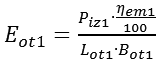
- specific radiation power reduced to the area of the reflector-reflector, W / m2, Ln1 Is the current value of the distance from the radiation surface, m. In the calculations by formula (4), the value of the volumetric opening angle of the ray flux at the exit from the reflector-reflector is taken α1= 70 °.
Figure 3 shows the obtained graph of the distribution of the specific radiation power along the normal to the emitting surface. The dots mark the obtained boundary distances of the heating zones: L1max = 1.35 m, L1min = 2.5 m, for the initial warm-up period, L2max = 1.8 m, L2min = 3.2 m, for the period of thermal stabilization.
Figure 4 shows the heating diagrams of a 4 m long room with a ceiling height of 2.5 m, which is equipped with an SLO in the form of an EIUS-211, placed on the wall at a height of 1.8 m with the direction of the reflector-reflector diagonally of the room at an angle of 27-30 ° downward. in relation to the horizontal. The highlighted volumetric arrangement of heating zones on the diagrams with the possibility of changing the location of the electric heater and the direction of the radiant flux makes it possible to find the optimal location of the AO and objects of heating.
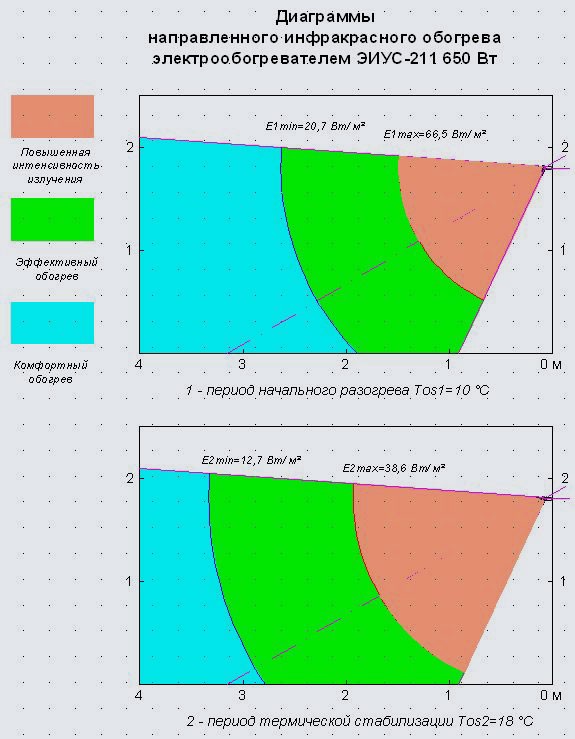
It should be noted that the above calculations and, on their basis, the zoning of the room according to the heating modes are valid for radiant irradiation of 50% and more of the human body. The optimal construction of the AO in this case determines the presence of two or more heaters located diametrically throughout the room or in a dedicated heating zone. In order to reduce the size of the zone of increased radiation intensity when thermal stabilization is achieved, the electric heater must be equipped with a stepped heating power switch.
The developed technique makes it possible to estimate the intensity of irradiation, for example, both at floor level and at the level of a person's head as one approaches the heater. Obviously, the installation of infrared heaters on the ceiling with the supply of radiation from top to bottom for rooms with ceilings with a height of 2.5-4 m will always create a radiation intensity of the human head much higher than the rest of the body. In this case, the head, as a rule, will be in a zone of increased radiation intensity, which does not allow to withstand the current radiation standards and sharply increases the intolerance of radiation heating by workers.
Literature:
1. Rabko A.E. Infrared ceramic emitters and electric heaters NOMAKONTM / A.E. Rabko et al. // Electronics info. - 2011. - No. 5. - S.26-29.
2. Rabko A.E. Heating of premises with infrared electric heaters NOMAKONTM / A.E. Rabko et al. // Electronics info. - 2013. - No. 9. - S. 45-48.
3. SanPiN 9-80 RB 98. Hygienic requirements for the microclimate of industrial premises.
4.SP 2.2.1.1312-03. Hygienic requirements for the design of newly built and reconstructed industrial enterprises. Appendix 2.
5.GOST 12.1.005-88. Occupational safety standards system. General sanitary and hygienic requirements for the air in the working area.
6.ISO 7726: 1998. Ergonomics of the thermal environment. Instruments for measuring physical quantities.
 English
  Русский