

Description
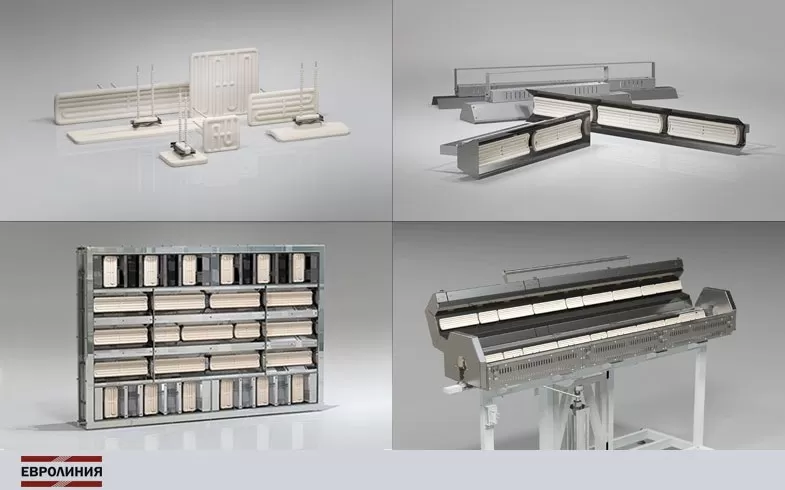
Designed for use as a source of directed long-wave radiation heat during heating and drying of various materials and products in technological processes.
One ceramic radiator is used as a heating element in the basic configuration of the EIUS-111 TSC-101-0.65 / 230-1.
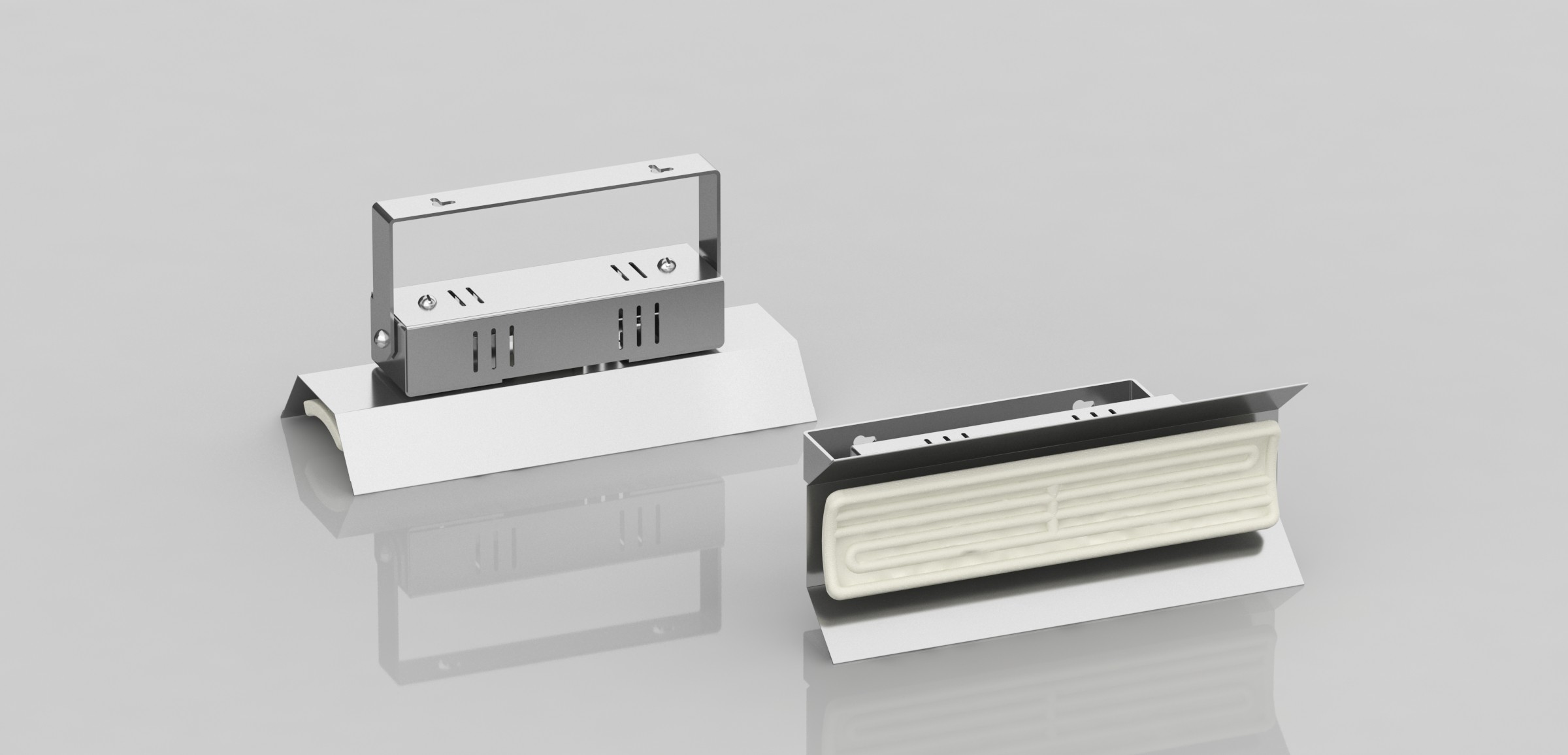
When forming a section of heaters for surface heating of materials and drying, ICN-101 emitters with a power of up to 1000 watts can be installed in the ERIUS housing.
If it is required to control the power of infrared heating by the temperature of the radiating surface, then a corresponding radiator of version 2 with a thermal sensor in the form of a thermocouple THA (chromel-alumel) type "K" is installed in the housing.
The distance from the radiation surface of the heater to the surface of the heated material in technological processes is, as a rule, from 100 to 250 mm.
-
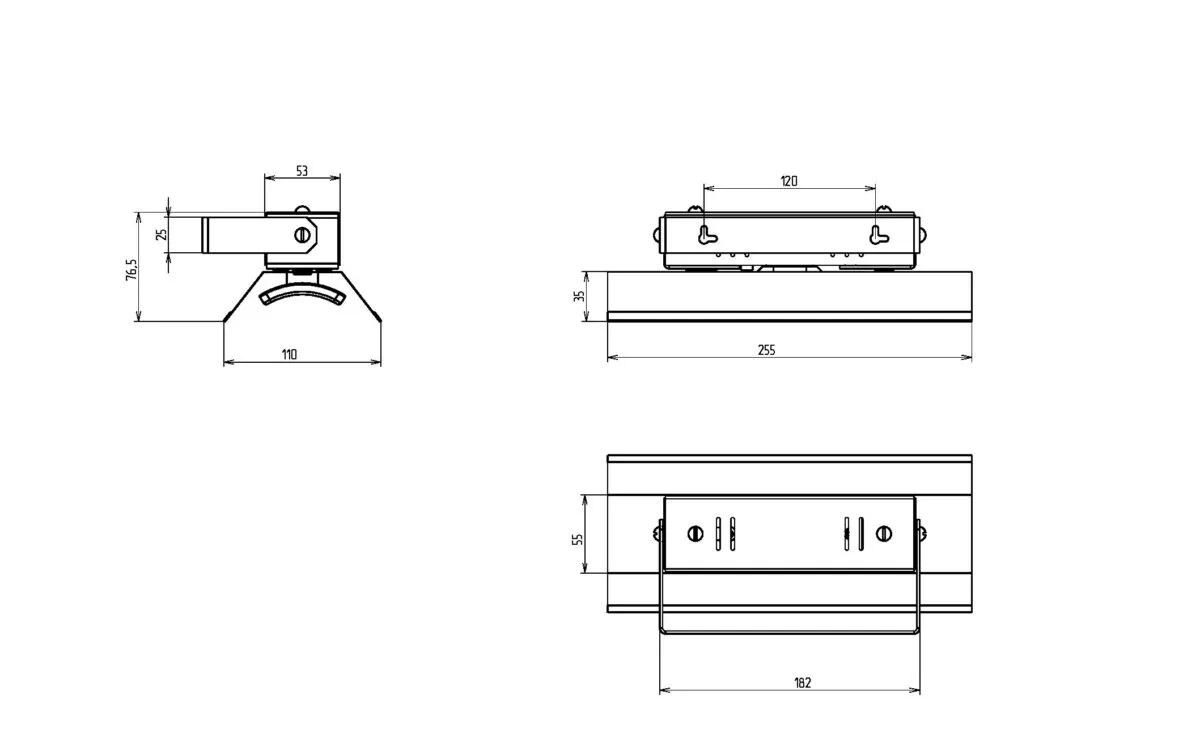
Overall and installation dimensions
Benefits
The main advantages of EIUS infrared heaters for industrial applications
- Ceramic emitters form "soft" long-wave radiation IR-C with a share of short-wave radiation IR-A by specific power not more than ηA = 0,5% and with a fraction of medium-wave radiation IR-B no more ηB = 20%.
- They are protected from corrosion and climatic factors: the reflector and the heater housing are made of high-alloy polished stainless steel, the terminal box and the mounting bracket are made of carbon steel with solid galvanizing. In ceramic radiators, the coating of the radiating surface is made with an angobized ceramic glaze based on zirconium oxide, which, unlike quartz tubes and lamps, is absolutely not sensitive to dust and organic pollutants that are burned and removed from the surface with a brush. The glaze is not sensitive to high humidity and condensation on the surface when turned on, the presence of chemical compounds in the air of the working area. Thus, it is possible to manufacture heaters with climatic design UHL2 (operation outdoors under a canopy) and UHL5 (operation in rooms with high humidity – mines, basements with frequent condensation of moisture on the walls and ceiling).
- The design of the radiators makes it possible to install heaters on objects moving with acceleration and deceleration, for this reason, the heaters are resistant to vibration loads.
- They have an external grounding terminal and the 1st class of protection against electric shock.
- The average time to failure is determined by the operability of ceramic emitters and is: for emitters with a specific surface energy of radiation from 1.95 to 4.1 W / cm2 (500-650 ° С) not less than 7000 h, with radiation energy up to 1.95 W / cm2 - not less than 10,000 hours
Additional options
- High temperature performance – manufacture of heaters with the installation power of the IKN-101 emitters up to 1000 W and the maximum temperature of the radiation surface up to 750 ° C
- Climatic modification and degree of protection – manufacture of heaters with climatic design UHL2, UHL5 and degree of protection IP22, IP32 and IP44
- Electrical power and supply voltage – manufacture of heaters with a different electrical power and supply voltage from 127 to 400 V, not exceeding the limit values for this brand of radiators
- Extending the length of the electrical cable - the length of the connected cable can be increased. In this case, the cable can be equipped with an electrical plug of any type (single-phase, three-phase)
- Built-in temperature control sensor – a radiator of version 2 with a built-in thermoelectrode sensor (THA type K thermocouple) is installed in the heater housing to control the temperature of the radiating surface during heating
Specifications
| Indicator name | Electric power, Piz 1, W | ||||
|---|---|---|---|---|---|
| 250 | 400 | 500 | 650 | 1000 | |
| Dimensions of the radiator in plan, calculated area and emissivity (emissivity) of the radiating surface | 245x60 mm, Fiz1 = 170.9 cm², ε1 = 0.96 | ||||
| Dimensions of the reflector-reflector in plan, the reduced dimensions of the central elementary radiation surface and the reduced radius of the radiation surface | Lot1 = 270 mm, Bot1 = 100 mm L1 = 100 mm, B1 = 100 mm, R1 =  = 56.42 mm = 56.42 mm |
||||
| The assumed volumetric opening angle of the beam flux at the exit from the reflector | α1 = 70 ° | ||||
| The temperature of the emitting surface is maximum with the vertical direction of the reflector β1 = 90 °, Tiz 1, ° C(1) | 390 | 480 | 530 | 590 | 700 |
| Time to reach operating temperature when switched on(1), min, not more | 20 | 18 | 16 | 14 | 12 |
| AC supply voltage (50 Hz), V | 220/230 | ||||
| Working hours | Long-term under the supervision of GOST 16617 | ||||
| Climatic modification according to GOST 15150 | UHL4 | ||||
| The degree of protection against penetration of foreign objects IP according to GOST 14254 | 20 | ||||
| Electric shock protection class according to GOST R IEC 536 | 1 class | ||||
| Curb weight, kg, no more | 1,2 | ||||
| 1 — достигается при температуре окружающей среды от +18 до +25 °С | |||||
| 2 - the characteristics for the basic configuration of the heater are highlighted in blue | |||||
Designation when ordering
Infrared electric heater ТУ BY 190454267.006-2015
EIUS-111-1,0/230-1-T1
|
EIUS-1 |
обозначение модели нагревателя (всего выпускаются модели ЭИУС-1, ЭИУС-2 и ЭИУС-3) |
|
12 |
designation of the modification "1 row and 2 emitters TSC-101" (in total, modifications 11, 12 and 13 are produced |
|
1,0 |
rated power consumption, kW. |
|
230 |
rated value of AC supply voltage, 220/230 V, 50 Hz. |
|
1 |
1-version with fixing bracket for ceiling and wall mounting, |
|
T1 |
the presence of one temperature sensor of the emitting surface (one TSC-101 emitter, version 2). |
Completeness
Электронагреватель инфракрасный ЭИУС в сборе — 1 шт.
Passport, installation and operation manual(1) — 1 шт.
Коробка упаковочная — 1 шт.
(1) – when delivered, one passport can be issued for several heaters from the same batch
Heater installation options
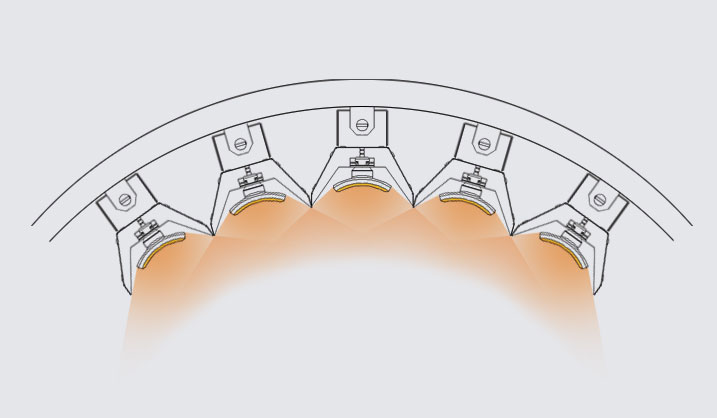
- In the case of single or group use of heaters in the form of an industrial heating section of the material in the technological process (see Fig. 1), it is necessary to provide control of the heating power by the temperature of the emitting surface of the radiators.
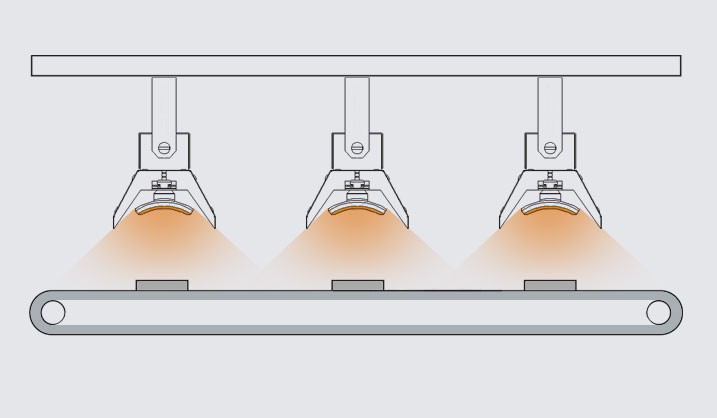
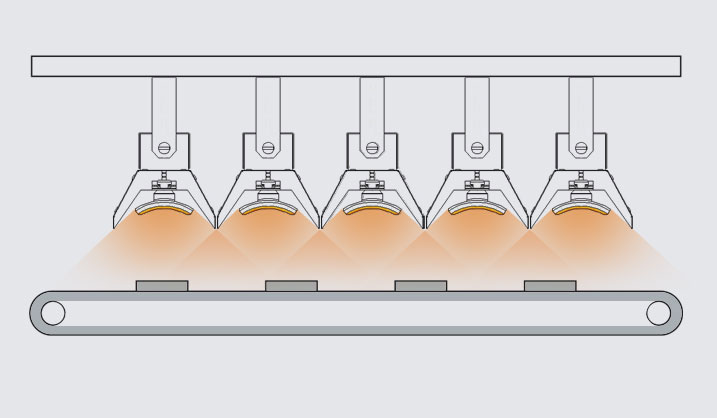
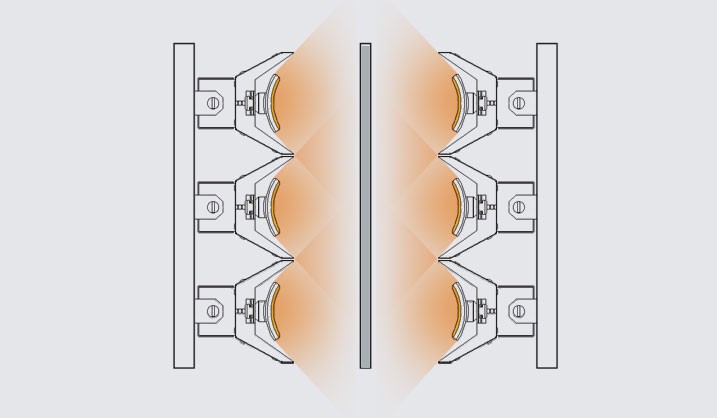
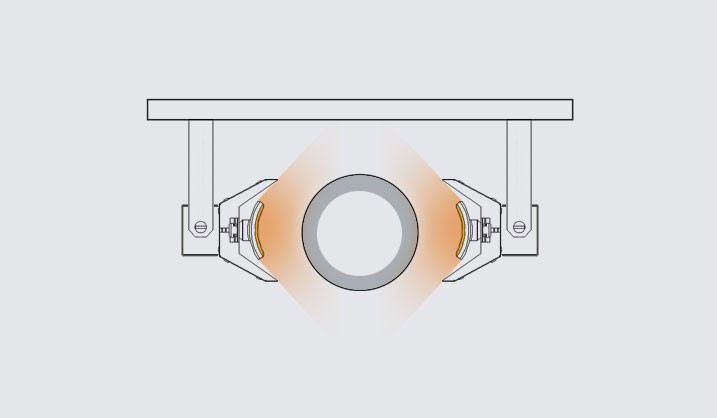
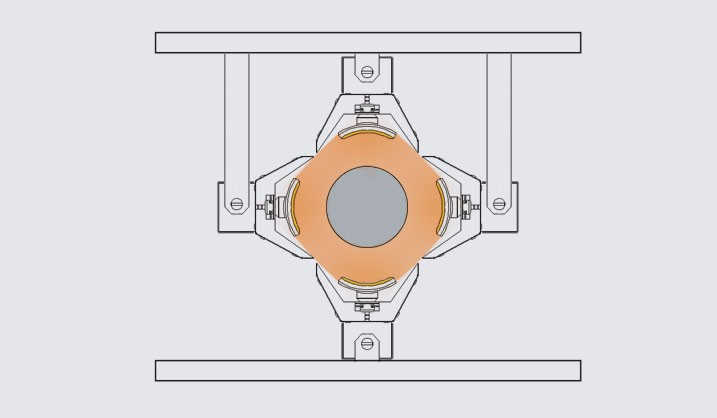
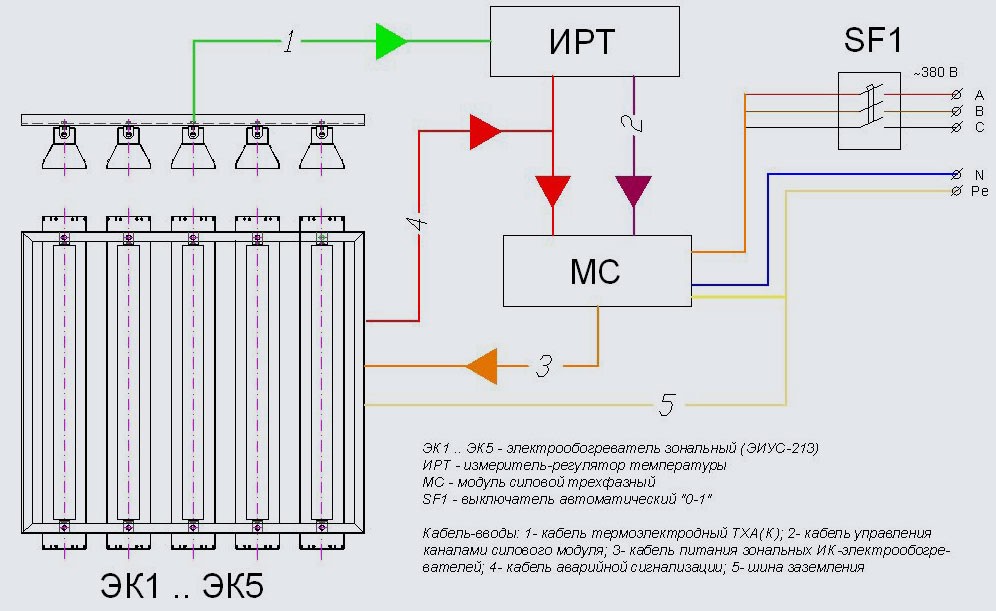
- Each heater, or one for the entire section, can be equipped with an emitter with a temperature sensor connected via a thermoelectrode cable to an IRT temperature meter-controller device. (see Fig.2) IRT, using a power MS module, controls the supply of power voltage to electric heaters, maintaining the set temperature of the emitters, i.e. the IR heating power of each zones. At the same time, the IRT protects the emitters from overheating, and the automation built into the MS constantly monitors the operability of the emitters and generates an "ACCIDENT" signal (light, sound) indicating the appropriate zone if an electrical circuit breaks when one of the emitters fails, or when the circuit is short-circuited.
Safety requirements
- Is prohibited install and turn on heaters having radiators with a damaged (split) ceramic surface, with split ceramic insulators on current-carrying wires, with damaged current-carrying wires and tips, damaged housing and terminal box.
- Is prohibited exceed the rated supply voltage of the heater due to possible overheating of the radiating surface above the maximum permissible temperature plus 750 ° C.
- Is prohibited close the space in front of the radiators when the heater is turned on: the space in front of the radiating surface should always be open for the output of infrared radiation (removal of thermal energy).
- Is prohibited cover the included heater: an unregulated decrease in heat dissipation by infrared radiation and thermal convection causes overheating of the radiators and the heater housing, which leads to a fire hazard situation.
- The power cable must not come into contact with the hot surfaces of the heater.
- When installing the heater tocategorically prohibited direct the beam stream to nearby walls, ceiling or floor, if the distance to them is less than 1.5 m.
- Isprohibited use EIUS heaters in rooms with explosive and fire-hazardous environments of categories A, B, B1-B4 and G1, as well as on the territory of outdoor installations of categories An, Bn and Vn according to TCP 474-2013 "Categorization of premises, buildings and outdoor installations for explosion and fire hazard".
manufacturer's warranty
- The manufacturer guarantees the compliance of the product with the requirements of the current regulatory documentation, subject to the conditions of transportation, storage, installation and operation.
- The shelf life is 2 years from the date of manufacture.
- The warranty period is 12 months from the date of commissioning (sale), or from the date of manufacture in the absence of the date of sale.
- During the warranty period, the consumer has the right to replace the faulty emitter through the point of sale from which it was purchased.
- The warranty does not apply to emitters without a passport with a mark of sale, incomplete, having mechanical damage or other signs of violation of the rules of transportation, storage and operation.
 English
  Русский