

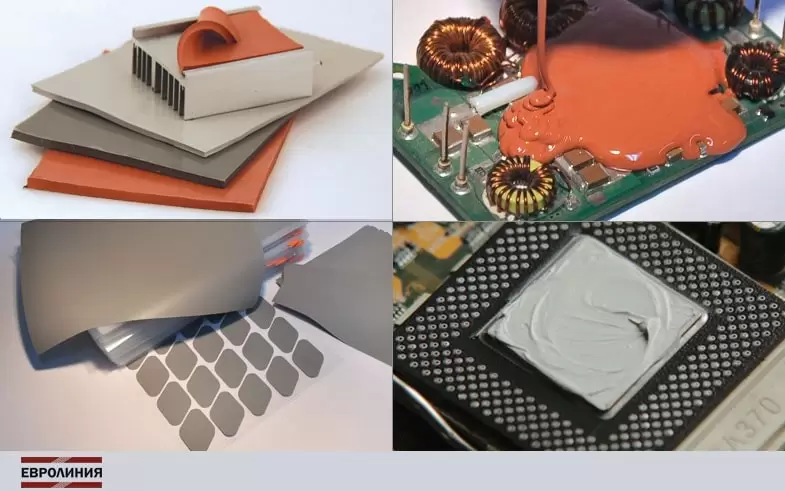
Thermally conductive silicone pastes NOMACON ™ KPTD-3
The company "Eurolinia" offers to buy its customers a heat-conducting dielectric paste KPTD-3, made on a non-drying organosilicon bond.


Qualitative indicators:
Ceramic-polymer thermally conductive dielectric (KPTD) materials NOMAСON ™ KPTD-3 are professional heat-conducting heat-resistant pastes on a non-drying organosilicon (silicone) base. Heat-conducting pastes are designed to ensure effective thermal contact between two touching or adjacent surfaces in apparatus and equipment for various purposes, as well as when removing heat from microcircuits, transistors and other electronic elements. Thermal pastes significantly reduce the contact thermal resistance and are recommended for use in the operating temperature range from minus 60 ºС to plus 180 ºС in products of thermal, electrical and electronic equipment.
Organosilicon heat-conducting pastes NOMACON KPTD-3 provide effective heat removal and electrical insulation due to the increased heat-conducting and dielectric properties of the applied ceramic fillers in the form of micropowders of various chemical and dispersed compositions.
- Visco-plastic properties, increased adhesion and hiding power to metal, glass and ceramic surfaces make it easy to apply pastes in a thin layer on the contact surfaces during assembly, as well as mechanically remove or wash off with a solvent during disassembly.
- Thermal pastes KPTD-3 are chemically inert, explosion-proof, non-flammable, do not have an irritating and general toxic effect on the body (classified as class IV - low-hazard substances according to GOST 12.1.007.
During operation at elevated temperatures, the pastes do not dry out and do not emit harmful substances. - Does not cause corrosion of metals and alloys.
- It is not required to deactivate the waste of KPTD-3 thermal pastes. Transportation, storage and use of pastes does not require special safety measures, as well as the use of personal protective equipment.
Heat transfer pastes NOMAСON ™ KPTD-3 are produced with different thermal conductivity depending on the composition of the ceramic filler. The marking is based on the design according to the composition of the heat-conducting ceramic filler (compositions 1, 2, 3) with the corresponding standardized thermal conductivity.
Thermally conductive pastes are used to effectively remove heat from various elements of electronic equipment. Thermal pastes KPTD-3 have found application in household appliances, in particular, in providing heat removal from processors and video chips of personal computers and laptops. The very same paste is available in 3 types:
Heat-conducting paste KPTD-3/1 is made on the basis of micropowders of highly purified oxide ceramics, recrystallized using a special technology at temperatures above 2000 ° C (α-Cristalen ™).
Heat-conducting paste KPTD-3/2 is made on the basis of oxide and nitride ceramic micropowders, sintered using a unique technology in a highly purified nitrogen environment at temperatures above 1200 ºС (β-Cristalen ™).
Heat-conducting paste KPTD-3/3 manufactured on the basis of nitride ceramic micropowders.
Heat-conducting pastes NOMACON ™ KPTD-3 are packed in polymer syringes with a net weight of 5 g and 10 g, in polymer cans with a net weight of 20-100 g, in polymer buckets with a net weight of 0.25-2.0 kg.
Specifications
Technical characteristics of heat-conducting pastes NOMACON ™ KPTD-3
|
Name |
Standard according to TU RB 100009933.004-2001 rev. 4 |
Control methods |
|||
|---|---|---|---|---|---|
|
Brand |
|||||
|
KPTD-3/1 |
KPTD-3/2 |
KPTD-3/3 |
|||
|
Appearance |
Homogeneous viscous-plastic non-flowing mass without mechanical impurities |
GOST 19783 |
|||
|
Color |
Pink, gray, white (¹) |
Brown, gray (¹) |
Grey |
Visually |
|
|
Density, g / cm³ |
2,15-2,25 |
2,00-2,10 |
1,90-2,00 |
GOST 3900 |
|
|
Brookfield dynamic viscosity at 23 ° С and shear rate 120 1 / s, mPa * s |
12000-18000 |
GOST 25271 |
|||
|
Electric strength, kV / mm, not less |
|||||
|
- at constant voltage |
15 |
13 |
12 |
GOST 6581 |
|
|
- with alternating voltage |
12 |
11 |
10 |
GOST 6581 |
|
|
Specific volumetric electrical resistance, Ohm • cm, not less |
1014 |
1013 |
1012 |
GOST 6581 |
|
|
Dielectric constant, no more, |
|||||
|
- 50 Hz, |
6,0 |
GOST 6581 |
|||
|
- 1 MHz |
4,0 |
GOST 6581 |
|||
|
Dielectric loss tangent, not more, |
|||||
|
- 1 MHz |
0,005 |
GOST 6581 |
|||
|
- 10 MHz |
0,009 |
GOST 6581 |
|||
|
Working temperature, ° С |
from minus 60 to plus 180 |
||||
|
Corrosive effect |
Lack of greenery on a copper plate |
GOST 9080 |
|||
|
Thermal conductivity, W / (m • K), not less |
0,80 |
1,00 |
1,20 |
ASTM D 5470 GOST 19783 |
|
|
Specific thermal resistance (²) (thermal interface), (K * cm²) / W, no more |
0,45 |
0,38 |
0,30 |
ASTM E 1530 |
|
|
(¹) - The color is consistent with the consumer |
|||||
Heat conducting properties
Heat-conducting properties of heat-conducting pastes KPTD-3
To assess the heat-conducting properties of heat-conducting pastes KPTD-3, a mathematical model for calculating thermal resistance is used, presented above on the site page "DESCRIPTION - Thermal resistance of KPTD-materials". In this case, the total specific thermal resistance to heat transfer R (see formula 2) includes thermal resistance at the boundary "heat-transfer contact surface - thermal paste" R1S, thermal resistance depending on thickness δ and thermal conductivity λ thermal paste layer δ / λ, as well as thermal resistance at the border "thermal paste - heat-receiving contact surface" R2S... Measurements of R (ASTM E 1530) showed that in the range of thicknesses of the residual paste layer between high-quality contact surfaces (see "Instructions for use"), equal to 25-80 microns, the total specific thermal contact resistance RS insignificantly and amounts to 0.045-0.055 (K⋅ cm²) / W.

Due to the high viscous-plastic properties and the ultradispersed composition of the ceramic filler, the thickness of the thermal paste layer NOMAСON ™ KPTD-3 stabilizes at the level of 25-35 microns even at insignificant compression stresses of 0.2-0.7 MPa.
To calculate the thermal resistance of a layer of heat-conducting paste RF (see formula 4) with a compressive stress of contact surfaces in the range of 0.2-1.7 MPa, the following values should be taken residual thickness of the paste layer and the total specific contact thermal resistance RS:
- thermal paste KPTD-3/1 δ = 0.032 mm, RS = 0.055 (K⋅ cm²) / W
- thermal paste KPTD-3/2 δ = 0.032 mm, RS = 0.050 (K⋅ cm²) / W
- thermal paste KPTD-3/3 δ = 0.029 mm, RS = 0.045 (K⋅ cm²) / W
In this case, the value of thermal conductivity for a given brand of heat-conducting paste λ taken from the table "Specifications", or from the certificate of quality, which is attached to the supplied products.
Example 4.
The heat-dissipating surface area of the processor on the motherboard is F = 6.25 cm2... It is required to determine the thermal resistance of the layer of heat-conducting paste RF to assess the adequacy of the heat dissipation from the processor to the cooler heatsink when using thermal paste KPTD-3/1, as well as to calculate the temperature difference ΔT between the processor surface and the heatsink at the value of the dissipated thermal power Q = 65 W.
- Accept the value δ = 0.032 mm RS = 0.055 (K⋅ cm²) / W for the residual layer of thermal paste KPTD-3/1;
- From the certificate of quality, we take the value of the thermal conductivity of the paste λ = 0.84 (W / m⋅K2) ;
- We count R = RS + δ / λ, R = 0.436 (K⋅ cm²) / W;
- Determine the value of RF according to formula 4: RF = 0.070 K / W;
- We calculate the temperature difference using formula 1: ΔT = RF ⋅ Q ΔT = 4.53 ° C.
For example 3, when using the heat-conducting paste KPTD-3/3, we have:
δ = 0.029 mm, RS = 0.045 (K⋅ cm²) / W, λ = 1.24 W / (m⋅ K), R = 0.279 (K⋅ cm²) / W, RF = 0.045 K / W, ΔT = 2.90 ° C.
Designation when ordering
Heat-conducting silicone paste
NOMACON ™ KPTD-3/1 THAT RB 100009933.004-2001,
or
Thermal paste KPTD-3/1 THAT RB 100009933.004-2001
Where KPTD-3/1 - material grade;
-3 - material of the third type (heat-conducting silicone paste);
/1 - the first type in terms of the composition of the ceramic filler (in total, the compositions of the ceramic filler 1, 2 and 3 are included;
Directions for use

- The surface to be applied with heat-conducting paste must be thoroughly cleaned of dust, dirt and other debris with hair brushes, cloth napkins or by blowing with compressed air. To remove moisture, traces of mineral oils, as well as grease stains and other contaminants, degrease the surface with a cloth soaked in solvent BR-2 gasoline TU 38.401-67-108, nefras C2-80 / 120 according to the manufacturer's TNLA, or in isopropyl alcohol TU 2632- 015-11291058. After solvent treatment, wipe the surface immediately with a dry, clean cloth. Then, in the same order, carry out a second degreasing.
- Apply heat-conducting paste to the surface with a brush, spatula, syringe. With careful smearing on the surface, achieve complete filling of all microroughnesses with the paste with squeezing out the residual air.
- The thickness of the working layer of the heat-conducting paste depends on the flatness and parallelism of the mating surfaces during installation and, if possible, should be minimal: when compressed with a layer of paste, no air pockets should remain between the surfaces, and excess paste should be squeezed out.
- The optimal thickness of the residual paste layer for high-quality surface preparation (roughness not more than Ra = 0.63 microns according to GOST 2789, deviation in flatness and parallelism of surfaces during assembly not higher than accuracy degree 7 according to GOST 24643) should be 25-80 microns (see figure ).
manufacturer's warranty
- The manufacturer guarantees the compliance of KPTD-3 heat-conducting pastes with the requirements of technical specifications, subject to the conditions of transportation, storage and use.
- The shelf life of heat-conducting paste in a closed container of the manufacturer is 18 months from the date of manufacture.
- After the expiration of the consumer's shelf life, the heat-conducting paste is tested for compliance with the technical requirements before each use. Subject to compliance, heat transfer paste can be used for its intended purpose.
- Complaints and claims for quality are accepted when products are returned in the manufacturer's container with the provision of copies of accompanying documents for the products received from the manufacturer (invoice, quality certificate).
Pastes are supplied in packages of various sizes: syringes - 5 - 10 g each, in plastic containers from 0.1 to 2 kg, which is convenient for use both in domestic conditions and in production.
You can buy KPTD-3 thermal paste wholesale and retail by referring to the contacts section of our website.
 English
  Русский