

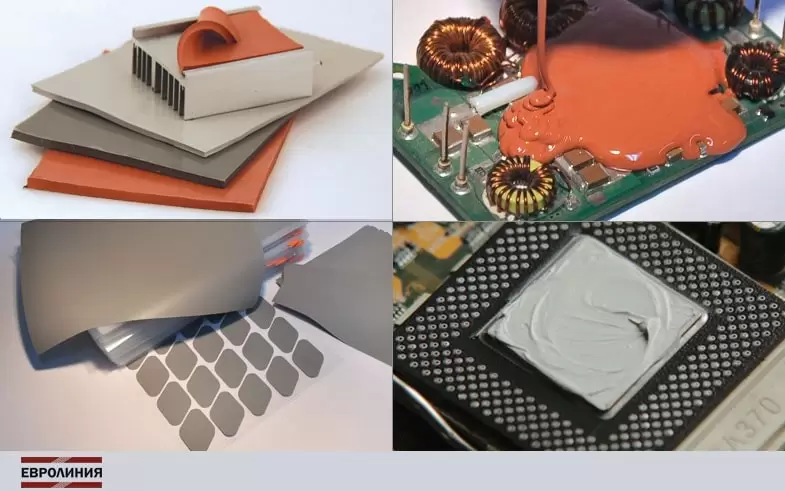
Description of heat-conducting dielectric materials KPTD
Ladies and gentlemen! We have developed new highly heat-conducting materials KPTD-2-VN, KPTD-2M-VN with thermal conductivity from 2 to 2.5 W / mK. The new materials, along with high density, are characterized by excellent elasticity and conformity, providing low thermal resistance.
Ensuring effective thermal contact through the use of appropriate heat-conducting electrical insulating materials is essential in a variety of industries.
Ceramic-polymer thermally conductive materials are highly filled silicone thin-film elastomers, which are used for the production of thermally conductive elastic dielectrics - in the form of sheet gaskets, compounds and pastes.
The company "Euroline" produces various types of such materials with different thermal conductivity. You can buy heat-conducting materials by writing to managers in the contacts section of our website.
Company EUROLINIA offers modern innovative products NOMAСON ™ KPTD (Ceramic-Polymer Thermally Conductive Dielectric Materials), allowing to solve the most complex problems in the field of heat removal and "thermal control".
Our products reflect the main achievements of 20 years of work in the market of heat-conducting electrical insulating materials, the results of continuous improvement of formulations and production technology in order to obtain the required mechanical and dielectric characteristics of KPTD materials in combination with high heat-conducting properties and a competitive price.
KPTD materials include ceramic heat-conducting dielectric fillers in the form of micropowders of various natures and various dispersed compositions, which are distributed in a certain way in an elastic matrix - in heat-resistant silicone rubber (compounds and sheet materials), or in heat-resistant polydimethylsiloxane liquid (pastes and lubricants).
Developed new types of ceramic fillers, such as α-Cristalentm and β-Cristalientm, selected dispersed compositions and found optimal ratios of components made it possible to offer a wide selection of materials with specified standardized physical, mechanical, heat-conducting and electrical insulating properties.
KPTD-materials are produced according to TU RB 100009933.004-2001 rev. 4. For the first time in the CIS, we have mastered, registered and applied for the control of heat-conducting characteristics the generally recognized international standards for determining the thermal conductivity and thermal resistivity of electrical insulating materials ASTM D 5470-06 and ASTM E 1530-06.
The presented standardized materials, as well as sheet materials and gaskets of various thicknesses and sizes, made according to the customer's drawings, we are always ready to release in the smallest possible batches and even single items. We constantly cooperate with our customers in the field of innovations - we develop new products to order, manufacture and supply prototypes for testing, offer methods for calculating thermal processes using our materials.
Currently materials NOMAСON ™ KPTD is constantly used in their products and developments by more than 300 manufacturing enterprises, research institutes and design bureaus from the CIS and Baltic countries.
The guarantee of the quality and reliability of our products is long-term contracts for the supply of KPTD materials to leading manufacturers
- auto electronics
- heating elements and electric heating devices
- television and video equipment
- power supply units and power converters
- measuring and diagnostic equipment
- electric motors and solenoids
- LED panels and lighting fixtures
- sensors and control devices
- refrigeration equipment.
Advantages of NOMACON ™ KPTD materials
- technical characteristics at the level of the world's leading manufacturers
- cost is 2-3 times lower than foreign analogues
- minimum production and delivery time (no more than 7-10 days),
- minimum lots - work with single items and orders
- modern production facilities and technologies
- continuous improvement
- future orientation.
Elastic thermal interface
Ensuring the removal of thermal energy from a heating electronic device is one of the most important tasks for developers and manufacturers of electronic equipment. Increasing the functionality of devices, increasing their power with miniaturization of components, as a rule, leads to the need to dissipate more and more heat fluxes. In this case, the creation of an effective thermal contact through the use of appropriate heat-conducting electrical insulating materials is essential for the performance of the product, the stability and durability of its work.
Elastic thermal interface - efficient direction of thermal discharge of electronic devices
The process of heat transfer from the hot housing to the radiator, followed by heat dissipation by convection into the environment, we call the "natural thermal discharge" of the device.
The efficiency of thermal relief is determined by the following main parameters:
- the quality of performance of the heat-transfer surface of the housing of the electronic device 1, i.e. its flatness and roughness;
- the design and workmanship of the heat-receiving and heat-dissipating surfaces of the radiator 2;
- the properties of a heat-conducting electrically insulating pad (substrate) that provides thermal contact between the housing and the radiator 3;
- conditions for ensuring thermal contact, i.e. the compressive force P of the surfaces of the device and the radiator, their flatness and parallelism during assembly, the presence of residual air cavities between the gasket and the clamping surfaces;
- the conditions of heat transfer from the radiator to the environment.
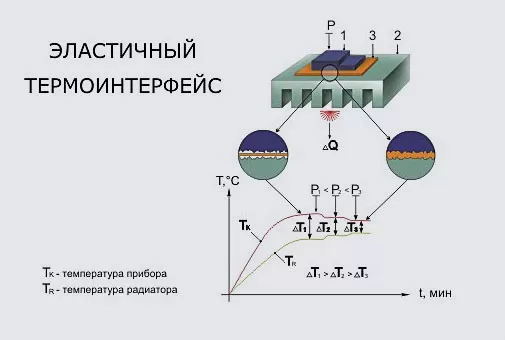
In practice, the designs of the housing and heatsink in electronic products are quite optimized for heat dissipation. Thus, the only structural element of the electronic assembly that limits heat transfer and whose heat transfer properties are amenable to correction is an insulating gasket. It is she, or rather, the thermal resistance that arises between the device and the radiator, which are separated by a gasket, and determines the design dimensions, power and performance of the entire device as a whole.
The higher the thermal resistance of the insulating pad, the greater the temperature difference ΔT is created between the case and the radiator, which, accordingly, increases the risk of overheating of the device and reduces its MTBF. It is obvious that at the current level of development of electronics, the insulating gasket does not play a secondary role. The maximum reduction in thermal resistance between the case and the radiator allows minimizing the heat transfer surfaces and dimensions of the device at the given power of the removed heat fluxes ΔQ.
When choosing a heat-conducting gasket, it is also important to ensure reliable electrical insulation between the device and the radiator, manufacturability and minimum labor intensity of assembly, the possibility of using the product in automated mass production technologies, and the optimal price-quality ratio.
When developing KPTD materials by specialists ODO "NOMACON" solutions have been found that allow maintaining a high level of heat-conducting and electrical insulating characteristics of materials, i.e. provide a combination of the highest possible thermal conductivity, dielectric strength and comfort material to the contact surface. The conformity of the material to the contact surface in this case means the possibility of its tight fit to the pressing surfaces with the displacement of residual air and repetition of the shape of the microrelief of the surface roughness in order to minimize contact thermal resistance.
The above properties are achieved by the maximum filling of elastomers with heat-conducting dielectric micropowders of optimal dispersed composition in combination with a high degree of residual elasticity obtained after polymerization of the material, its expressed thermal relaxation, as well as the formation of a smooth and even (glossy) surface for sheet materials KPTD-2 and KPTD-2M.
Thus, even at low compressive stresses P1 <P2 <P3 KPTD materials can significantly reduce thermal resistance ΔT1> ΔT2> ΔT3 and ensure effective elastic thermal interface.
Thermal resistance of KPTD materials
According to the equation of heat transfer by thermal conductivity through a flat wall (gasket), the amount of heat transferred per unit of time (heat flux) ΔQ, W, directly proportional to the temperature difference of the heat-dissipating T1S, ° С, and heat-receiving T2S, ° С, surfaces, directly proportional to the heat transfer surface area (gaskets) F, m2, and inversely proportional to the total specific thermal resistance to heat transfer R, (K • m2) / W:

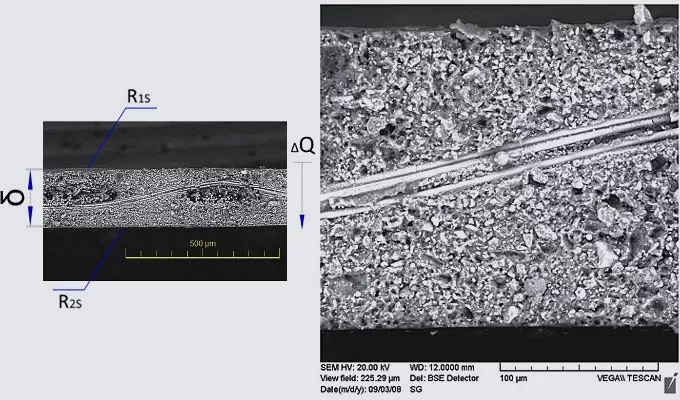
Total specific thermal resistance to heat transfer R in this case, according to the additivity rule of thermal resistance, it consists of three components: thermal resistance at the boundary "heat-transfer contact surface - gasket surface" R1S, thermal resistance, depending on the thickness δ and thermal conductivity λ gasket material δ / λ, as well as thermal resistance at the interface "gasket - heat-receiving contact surface" R2S:

By constructing a linear relationship based on the test results (ASTM D 5470, ASTM E 1350) R = ƒ (δ) for a given grade of KPTD-material, it is possible to determine the total specific contact thermal resistance at the interface "contact surface-material" RS= R1S + R2S according to the schedule at the point δ = 0, and also determine the true thermal conductivity of the gasket material λ, W / (m • K):

Having determined experimentally for various materials the values RS and λ it is possible to accurately calculate the total specific thermal resistance to heat transfer R, and knowing the surface area of the gasket F, calculate its thermal resistance RF, K / W, for different material thicknesses:

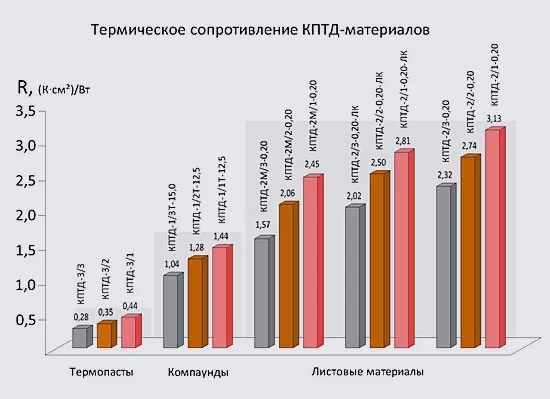
The diagram below shows the values of the total specific thermal resistance. R KPTD-materials, determined in comparable operating conditions of these types of materials.
For compounds KPTD-1 the nominal layer thickness when the radiator was glued onto the heat-dissipating surface of the device was δ = 0.1 ± 0.05mm, sheet materials KPTD-2 tested at nominal sheet thickness δ = 0.2 ± 0.015mm, the thickness of the residual layer of thermal grease KPTD-3 when tested was 20-35 microns. The results are obtained with the compressive stress of the clamping surfaces P = 0.69MPa (100 psi), material temperature 80-110 ° С and heat flux density 4.5-9 W / cm2... Clamping surfaces were made according to ASTM D 5470, ASTM E 1350 in the form of discs with a diameter of 32 mm (heat transfer surface F = 8.04 cm², gasket format T0-3), as well as in the form of discs with a diameter of 50 mm.
The measurement results showed that thermal paste KPTD-3 during compression, a minimum thickness of a layer of heat-conducting material is formed due to visco-plastic properties and at the same time, due to high adhesion and comfort to the surface, they provide a minimum total contact thermal resistance at the level RS = 0.045 - 0.055 (K • cm²) / W... When filling with compounds KPTD-1 with subsequent compression after polymerization, the material's conformity to the surface is slightly reduced in comparison with thermal pastes, and the contact thermal resistance increases: RS = 0.17 - 0.22 (K • cm²) / W.
Further, according to the degree of conformity to the contact surface, sheet materials with increased elasticity follow KPTD-2M: RS = 0.19 - 0.23 (K • cm²) / W... Surface application of standard sheet material KPTD-2 sticky adhesive layer (LC) or sticky positioning lubricant (LP) also increases comfort compared to non-sticky material, and at the same time RS = 0.55 - 0.80 (K • cm2) / W... For standard elastic sheet material KPTD-2 no sticky layer RS = 0.90 - 1.05 (K • cm²) / W.
Thus, based on the results obtained, the total specific contact resistance RS should be considered a fairly objective comparative indicator of the conformity of the CPTD materials to the contact surface. In the materials presented below, this indicator is used for the estimated calculation of the thermal resistance of heat-conducting materials. NOMAСON ™ KPTD.
Elasticity (compressibility) of KPTD materials
Conformity of sheet materials KPTD-2 and KPTD-2M to the contact surface and, accordingly, the contact thermal resistance are largely determined by their elasticity. The elasticity (compressibility) of KPTD materials is characterized by the value of the elastic modulus E, MPa / mm, calculated from the magnitude of the absolute deformation of the material during compression, as well as the degree of compression of the material Δδ, %, calculated as the ratio of the magnitude of the absolute deformation of the sheet in compression to the initial thickness of the sheet material. Depending on the applied compression stress within σ = 0.07 - 40 MPa the maximum compression ratio at which no destruction of the material occurs can reach the value Δδ= 65-80%.
Rated working compressive stress σ10, MPa determines the permissible relative deformation of a sheet of material (compression ratio) within the range of up to 10% from its original thickness, at which the manufacturer guarantees its strength, electrical insulating and heat-conducting properties, presented in the normative documents for KPTD materials.
Ultimate compressive stress σ50, MPa, determines the degree of compression of the sheet of material in the range up to 50% from its original thickness at which there is no loss of elasticity, and subsequently, when the compression stress is removed, the material is restored to its original thickness and retains its properties. Operation of products made of materials is not allowed KPTD-2 and KPTD-2M when the limiting compression stress is exceeded. The curves of compression of sheet KPTD materials presented below were obtained according to GOST 26605 on samples with a diameter of 40 mm at a speed of movement of the compressing surface of 0.5 mm / min.
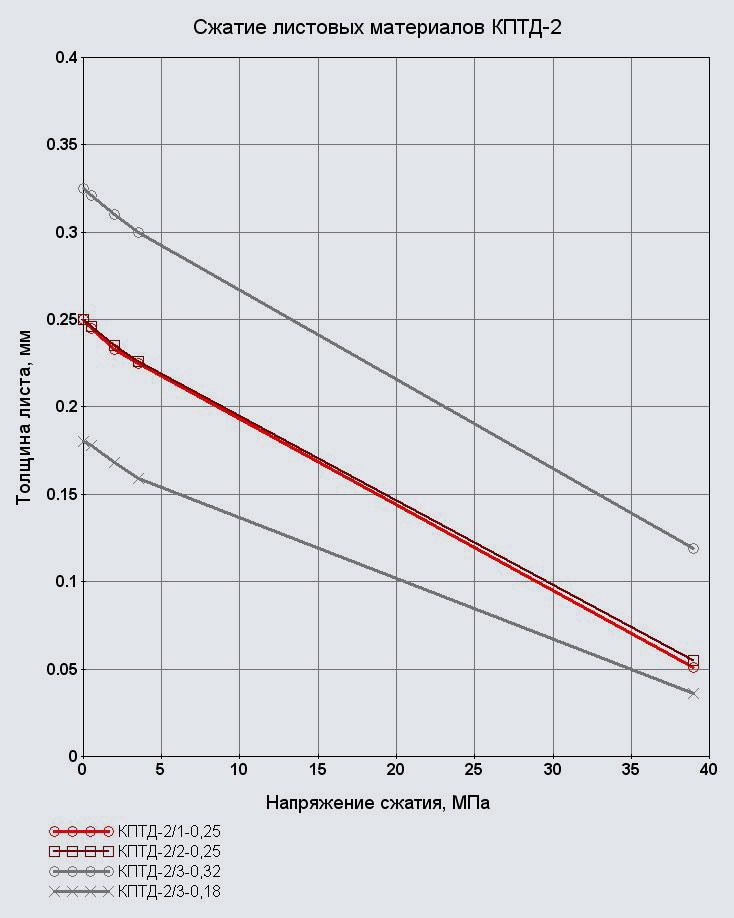
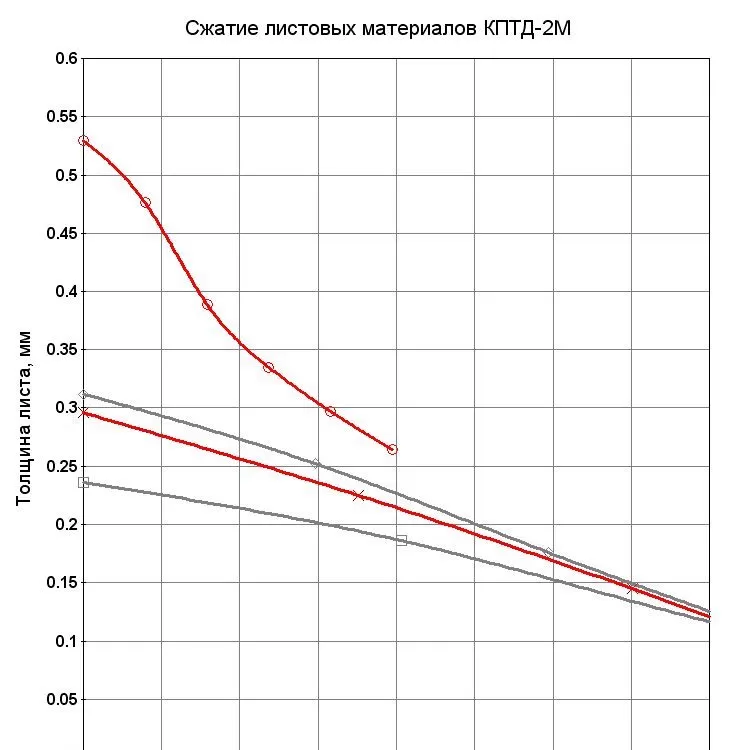
Calculation of the characteristics of compression and elastic deformation of sheet materials KPTD of various thicknesses allows increasing the accuracy of determining thermal resistance in practical problems of heat removal, as well as calculating the necessary compression forces to achieve maximum comfort (spreading) of the gasket between the contact surfaces.
Elasticity of standard sheet materials KPTD-2 0.18-0.35 mm thick is characterized by a linear nature of compression deformations up to the ultimate compression stresses σ50= 23.9 - 30.6 MPa... In the area of nominal working compressive stress σ10= 3.5 - 5.6 MPa residual material sheet thickness δ, mm, during compression it is possible to determine by the dependence:

Where δ0 - initial sheet thickness, mm; σ - compression stress, MPa; E - the modulus of elasticity of the material when calculating the absolute deformation of the sheet, MPa / mm.
Having determined the permissible compressive stress for a given type and thickness of material, it is possible to calculate the required compression force of the gasket. P, between contact surfaces:

Where F m2 - gasket area.
The relative deformation of the sheet of material (compression ratio) is calculated by the formula:

Based on expressions 5 and 7, the equations for calculating the permissible compressive stresses will take the form:
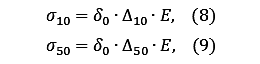
Where Δ10 = 0,1 and Δ50 = 0,5 - permissible working and limiting compression ratio of the sheet.
Results of experimental measurements of compression characteristics of sheet materials KPTD-2 0.15-0.55 mm thick and materials KPTD-2M with a thickness of 0.15-1.0 mm for the convenience of calculations according to formulas 4 and 5 were processed in the form of the dependence of the elastic modulus on the thickness of the original sheet.
For materials KPTD-2 an empirical dependence of the elastic modulus is obtained E1, MPa / mm from sheet thickness
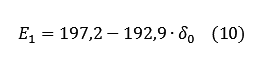
For materials KPTD-2 an empirical dependence of the elastic modulus is obtained E1, MPa / mm from sheet thickness
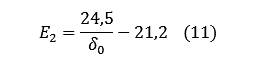
In equations (10) and (11), the values δ0 should be substituted in mm.

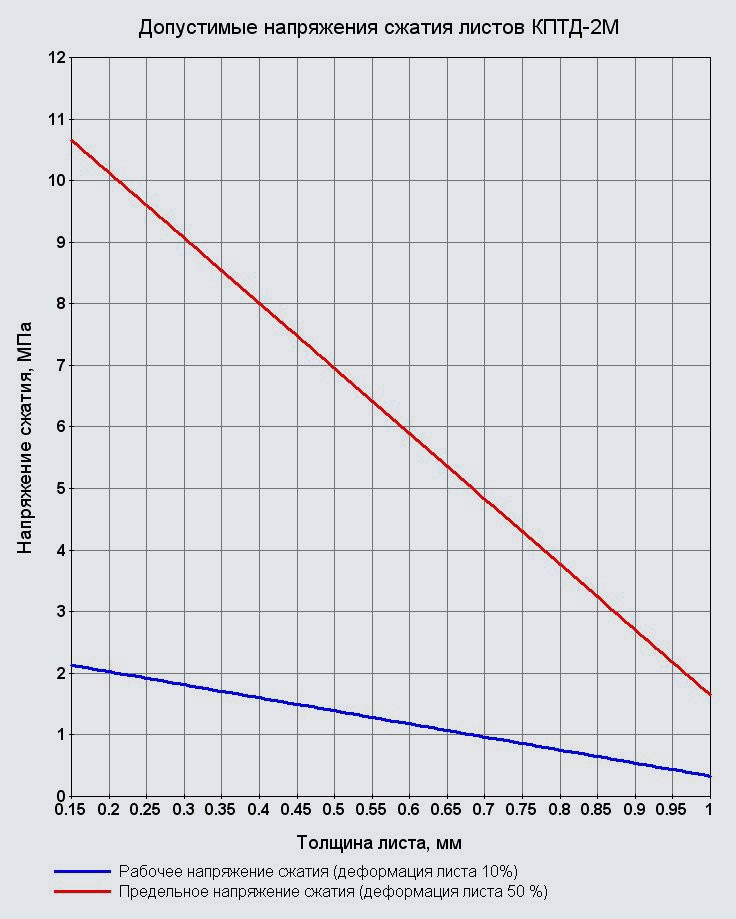
The obtained different nature of dependences (10) and (11) for the elastic moduli indicates a different nature of the deformation during compression of these types of materials. However, in both cases, with an increase in the thickness of the material, the elastic properties decrease, and the elasticity and flowability increase.
Comparative analysis of the elasticity of sheet materials KPTD-2 and KPTD-2M according to the values of the modulus of elasticity, it shows that with equal sheet thicknesses, the materials KPTD-2M have a modulus of elasticity 1.5-2.7 times less and, accordingly, have 1.5-2.7 times greater elasticity in compression. A similar comparison of materials in terms of the specific contact thermal resistance (conformity to the contact surface) RS shows that the values RS and E They correlate well with each other: the lower the value of the modulus of elasticity (or the higher the elasticity), the lower the specific contact thermal resistance (or the higher the conformity of the material to the contact surface).
The graphs show the results of calculations of the permissible compressive stress of materials. KPTD-2 and KPTD-2M according to formulas (8) and (9) using dependencies (10) and (11) for the corresponding elastic moduli. For materials KPTD-2 meaning σ110 and σ150 slightly increase with an increase in the thickness of the material with a linear decrease in the values of the elastic modulus. For materials KPTD-2M meaning σ210 and σ250 decrease linearly with increasing sheet thickness, which confirms the high plastic properties of the gel-like silicone polymer used.
Thermal relaxation of KPTD materials
Another important specific feature of elastic CPTD materials is their pronounced thermal relaxation,
Thermal relaxation - decrease in the value of thermal resistance in the joint "Heat-dissipating surface - heat-conducting material - heat-receiving surface" over time.
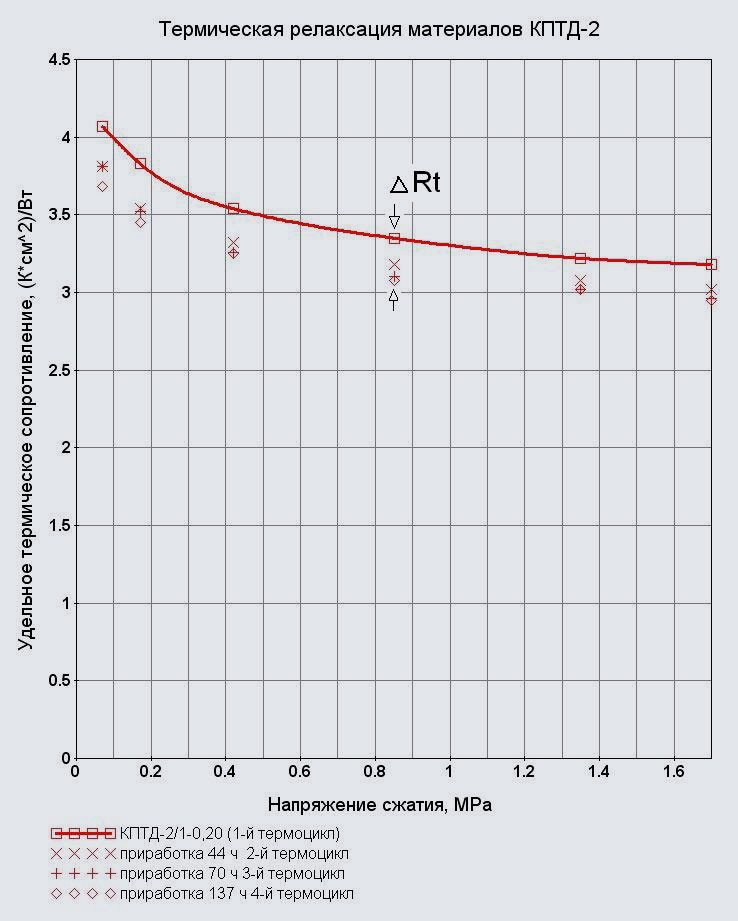
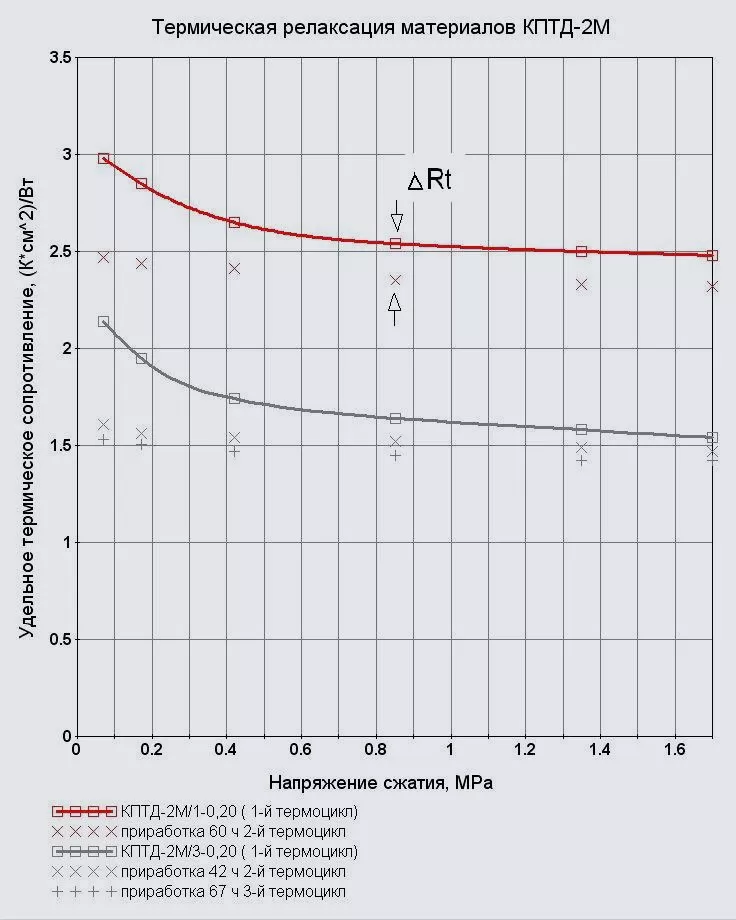
The magnitude of the relaxation decrease in thermal resistance ΔRτ depends on the type of material, the “running-in” time of the material (usually 20-150 hours) and the working compressive stress (0.07-1.7 MPa). The effect of thermal relaxation can be explained by the rearrangement of the internal heterogeneous structure of the deformed material from a nonequilibrium state to a more equilibrium one with an increase in the so-called internal three-dimensional cluster thermal conductivity. During the running-in time, the total specific contact resistance also decreases RS, i.e. the conformity of the material to the contact surface increases.
Thermal relaxation is most pronounced for sheet materials. KPTD-2 and KPTD-2M... The graphs show the dependences of the thermal resistance of materials on the compressive stress at different times of running in the material. In this case, the value of the relaxation decrease in thermal resistance ΔRτ is 5.5-17.0 % of the total thermal resistance R, determined during the first cycle of compression and heating (1st thermal cycle) when testing the material.
The size and shape of the produced sheets can also be agreed with the consumer. And the material itself today is one of the most popular heat-conducting dielectrics. To buy heat-conducting sheets, go to the "Contacts" section of our website.
 English
  Русский