

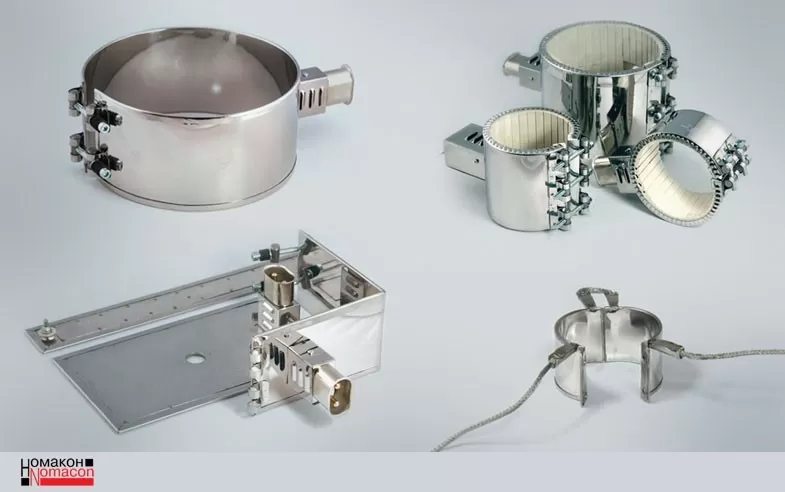
Description

Nozzle heaters are a type of ring heaters designed for contact heating of cylindrical surfaces and characterized by increased power. Typically, nozzle heaters are used in case of severe dimensional restrictions (such as exist, for example, in hot runner casting). This means that the contact area of the working surface of the heater with the heated surface is small, therefore, for efficient heating, an increased power density generated by the heater is required.
The heating coil, insulated with a layer of micanite, is located inside a housing made of stainless steel sheet. Due to the use of extremely high quality materials in the manufacture of nozzle ring heaters, a high level of reliability of this type of heaters and a long service life are achieved even under severe operating conditions.
Specifications

Main technical characteristics
| Minimum inner diameter, mm | 23 |
| Maximum inner diameter, mm | 150 |
| Minimum width, mm | 18 |
| Maximum width, mm | 150 |
| Thickness, mm | 4 |
| Maximum electrical power: ring, W / cm2 | 9 |
| Maximum electrical power: split, W / cm2 | 7 |
| Supply voltage, V | up to 1000 |
| Heater operating temperature, ° С | 450 |
The scope of application of nozzle ring heaters is wide - it is heating a variety of technological equipment (for example, nozzles / extruder heads, injection molds, injection molding machines, etc.).
Nozzle heaters are hermetically sealed - the metal sheath perfectly protects them from environmental influences, therefore, unlike conventional micanite ring heaters, they can be used where there is a risk of pouring with casting materials and other aggressive substances.
At the request of the customer, nozzle heaters are manufactured with holes, cutouts, thermocouple clamps, etc.
It is important to remember that holes and cutouts reduce the usable heating area, which means that the performance of the heater deteriorates.
When operating nozzle heaters, it is very important to observe the requirement to ensure tight contact between the heating surface of the heater and the surface of the heated object. If this condition is not met, an uneven release of heat energy from the heating surface of the heater occurs, which can cause its overheating (at least local) and, as a result, the heater fails.
It is important that the heated surface is of the correct shape and does not have shells, protrusions and roughness.
Electric nozzle heaters are installed on the technological heating object from the end surface. If such installation is not possible, then the heater can be made unbendable.
Types of current leads
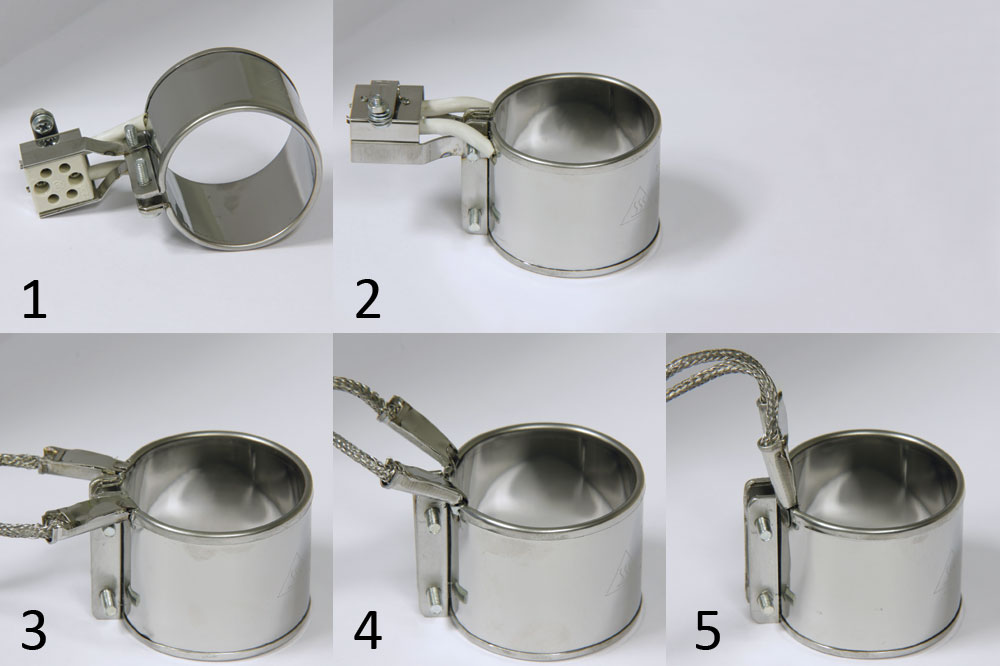
1 - nozzle terminal block;
2 - nozzle terminal block on the bar;
3 - nozzle thermal conduit 90;
4 - nozzle thermal conduit 45;
5 - nozzle thermal conduit along the axis;
 English
  Русский