

Description
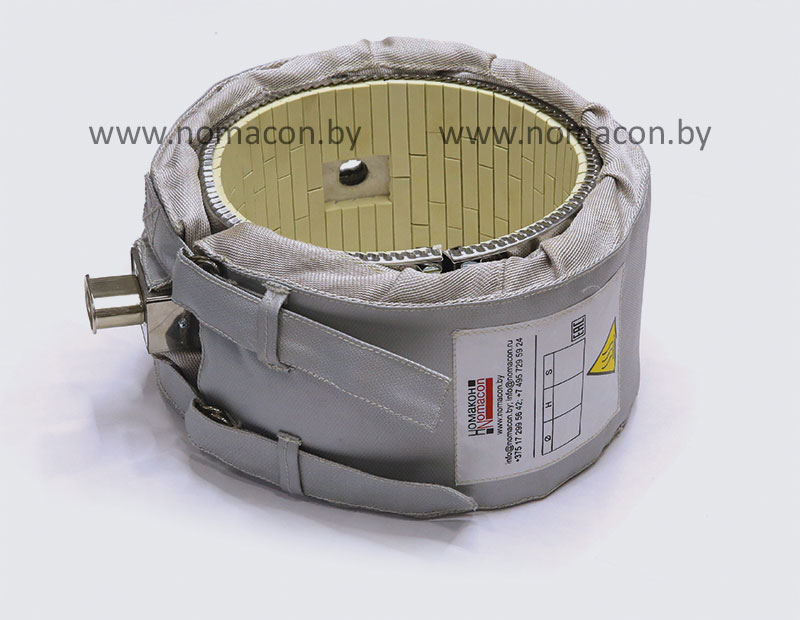
Energy-saving and heat-insulating thermomat of the company NOMAKON designed to save electricity by reducing heat losses. Lowering the temperature and infrared radiation on the surface of the heater will improve occupational safety and microclimate in the workplace.
Benefits
- Reduces energy consumption by 20-30%;
- Extends heater life due to shorter on-off cycles;
- Not flammable;
- Quick replacement, disassembly and assembly;
- Reducing the temperature of the hot surface of the heater by 60-70%;
- Improves labor protection and microclimate in the workplace;
- Temperature stabilization in the cylinder of the injection molding machine;
Typical energy savings for industrial heating elements in technological processes
| Operation type for plastics processing | Manufactured products | Average energy saving results |
|---|---|---|
| Injection molding | Thermoplastic products | 22.0 % |
| Extrusion | Polyethylene films, profiles, pipes | 19.0 % |
| Blown extrusion | Stretch films, multilayer films | 17.0 % |
Specifications
Insulation surface temperature (used as a guide)
Typical energy savings for industrial heating elements in technological processes
| The temperature of the sheltered element (° C) |
Insulation thickness (mm) | |||
|---|---|---|---|---|
| 25 | 50 | 75 | 100 | |
| Thermal insulation surface temperature (° С) | ||||
| 204 | 71 | 44 | 38 | 28 |
| 315 | 88 | 55 | 38 | 32 |
| 426 | 132 | 99 | 82 | 37 |
| 510 | 204 | 149 | 82 | 39 |
Thermomat design
Main technical characteristics
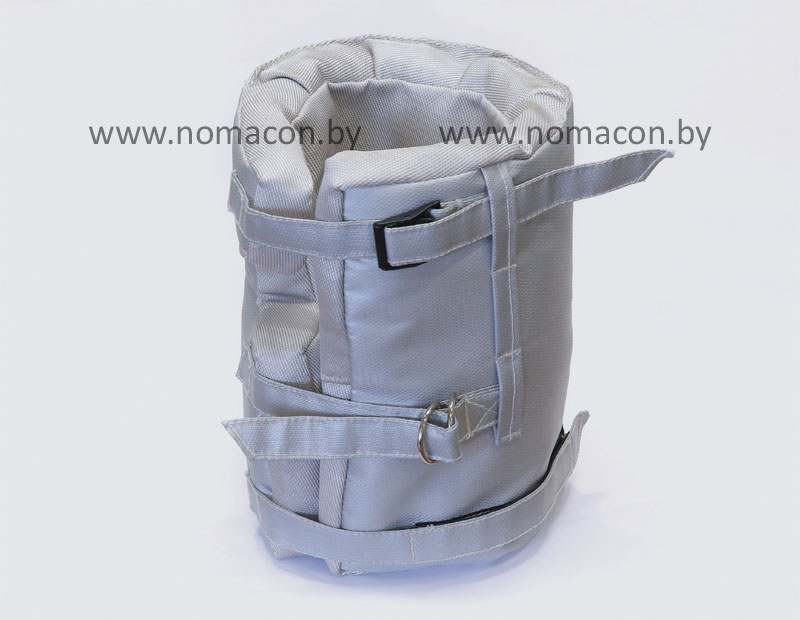
E-glass materials are used in the production of thermomats. The thermal insulation is sewn into a strong but elastic fiberglass. The outer surface of the "shell" has a double-sided silicone coating, and the side and inner surfaces are double-sided aluminum. The denser outer layer prevents the penetration of pollutants, dust and moisture onto the thermal insulation material. The presence of quick-release clamps allows you to quickly carry out equipment maintenance.
At the request of the customer, it is possible to manufacture thermomats with any technological holes (power supply to heaters, installation of temperature sensors, etc.)
Coefficient of thermal conductivity of material with a density of 180 kg / m3
| Working temperature (° С) | Thermal conductivity coefficient (W / m K °) |
|---|---|
| 50 | 0.037 |
| 100 | 0.042 |
| 200 | 0.054 |
| 300 | 0.064 |
| 400 | 0.084 |
| 500 | 0.102 |
 English
  Русский